Betriebsleiter und Prozessingenieure kommen zunehmend zur gleichen Erkenntnis: das konventionelle Kühlturmantriebssystem — bestehend aus Motor, Kupplung, langer Welle und Kegelradgetriebe — ist nicht nur wartungsintensiv, sondern wirkt wie eine permanente, kumulierte Energiebelastung. Dieser Beitrag erläutert die Technologie direktangetriebener Permanentmagnet-Motoren für Kühltürme, zeigt belastbare Effizienz- und Kostendaten und beantwortet die praxisrelevanten Fragen aus dem Engineering-Alltag.
- Das Antriebsproblem, über das kaum gesprochen wird
- Wie sich direktangetriebene PM-Motoren unterscheiden
- Wirkungsgrad in der Praxis: Was die Zahlen wirklich bedeuten
- Praxisbeispiel: 33 % gemessene Energieeinsparung
- 5-Jahres-Einsparprognosen nach Leistungsklasse
- Technische Daten: Baureihe SQMC
- Häufige Fragen aus der Praxis
1. Das unterschätzte Problem im Antriebsstrang
Ein klassisches Kühlturmantriebssystem sieht typischerweise so aus: ein TEFC-Asynchronmotor treibt über eine Kupplung eine lange horizontale Welle an, die wiederum ein rechtwinkliges Kegelradgetriebe speist, welches schließlich den Ventilator antreibt. Das System funktioniert — ist jedoch konstruktionsbedingt eine Kette von Verlust- und Ausfallstellen.
Getriebe in Kühltürmen arbeiten unter extremen Bedingungen — gesättigte Luft, permanente Vibration, Temperaturschwankungen und Wassernebel. Ölanalysen und Ölwechsel sind zwingend erforderlich. Wellenflucht verschlechtert sich über die Zeit, Lager und Dichtungen verschleißen schneller, Kupplungen altern. Jede mechanische Schnittstelle bedeutet zusätzliche Reibungsverluste.
Zusätzlich entstehen laufende Wartungskosten: Ölwechsel, Ausrichtung, Kupplungsinspektionen und Arbeitsaufwand. Diese Kosten gelten oft als „normal" — sind aber vermeidbar.
2. Was Direktantrieb grundlegend anders macht
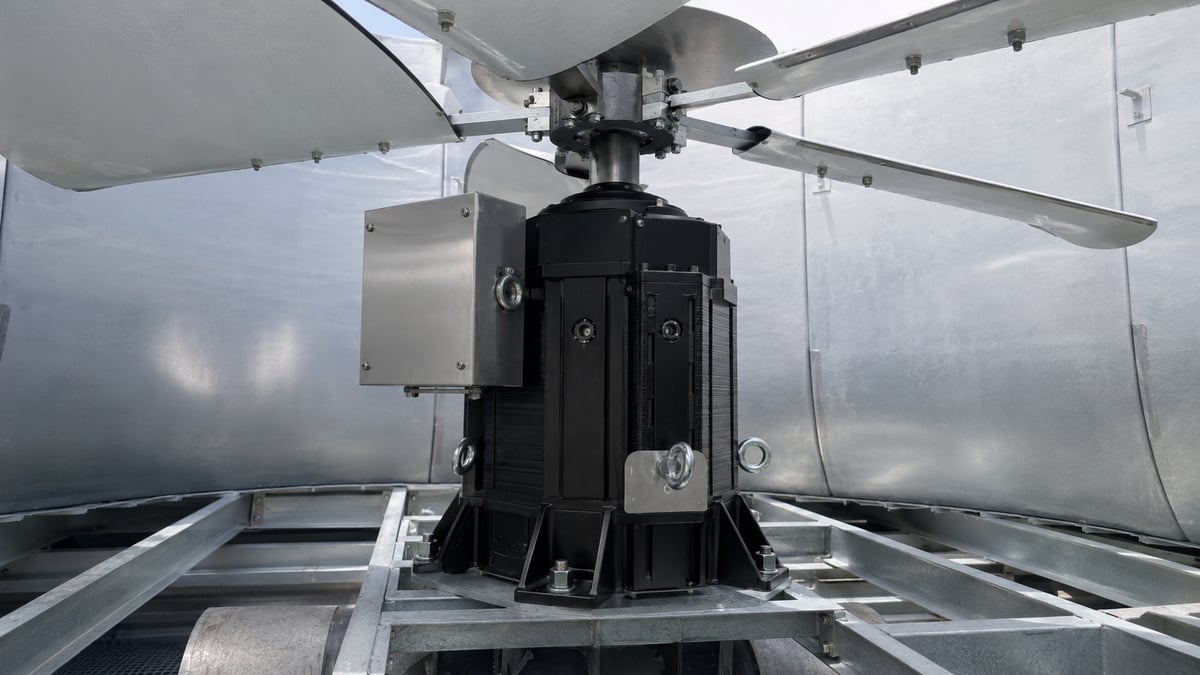
Ein direktangetriebener Permanentmagnet-Synchronmotor wird ohne Getriebe direkt mit der Ventilatorwelle verbunden. Keine Kupplung. Keine lange Welle. Kein Getriebe. Kein Öl. Der Motor arbeitet direkt auf dem benötigten niedrigen Drehzahlniveau — typisch 150–250 U/min — ermöglicht durch eine hohe Polzahl (66 oder 88 Pole in der SQMC-Serie).
Permanentmagnete im Rotor erzeugen das Magnetfeld ohne Erregerstrom — dadurch entfallen Rotorverluste vollständig. Die Drehzahlregelung erfolgt präzise über einen Frequenzumrichter (VFD). Sensorlose Vektorregelung ist Standard — ein Encoder ist in den meisten Anwendungen nicht erforderlich.
3. Wirkungsgrad: System vs. Typenschild
Effizienzklassen wie IE3 oder IE4 beziehen sich ausschließlich auf den Motor — nicht auf das Gesamtsystem. Sobald ein Getriebe vorhanden ist, verliert diese Angabe an Aussagekraft.
Beim Direktantrieb gilt: Das Drehmoment am Motor ist identisch mit dem am Ventilator. Der Wirkungsgrad des Motors entspricht dem Systemwirkungsgrad.
Die Baureihe SQMC liefert über das gesamte Modellprogramm folgende Nennwirkungsgrade:
| Motormodell | Pole | Leistung (kW) | Drehzahl (U/min) | Drehmoment (Nm) | Wirkungsgrad |
|---|---|---|---|---|---|
| SQMC132-150 | 66 | 6,5 | 200 | 310 | 94,5 % |
| SQMC132-200 | 66 | 8,4 | 200 | 400 | 95,0 % |
| SQMC132-250 | 66 | 10,5 | 200 | 500 | 95,5 % |
| SQMC200-300 | 88 | 23,0 | 200 | 1.100 | 93,5 % |
| SQMC250-500 | 88 | 58,6 | 200 | 2.800 | 95,0 % |
Ein weiterer Vorteil: PM-Motoren halten ihren hohen Wirkungsgrad über einen breiten Drehzahl- und Lastbereich — ideal für drehzahlgeregelte Kühltürme, deren Ventilatoren saisonal oder lastabhängig moduliert werden.
4. Praxisbeispiel: 33 % Energieeinsparung
Die folgenden Messdaten stammen aus einem Retrofit-Projekt unter identischen Betriebsbedingungen: ein konventionelles getriebebasiertes Lüftersystem wurde durch eine SQMC-Direktantriebseinheit von EMF Motor ersetzt, mit erfassten Stromverbrauchsdaten vor und nach dem Umbau bei gleichem Luftstrom und gleicher Ventilatordrehzahl.
Messergebnisse aus der Anlage — gleicher Luftstrom, gleiche Drehzahl
Strommessung vor und nach dem Umbau unter identischen Betriebsbedingungen.
Typischerweise liegen Einsparungen im Bereich von 15–25 % — abhängig von Zustand und Auslegung des bestehenden Systems. Das obige Beispiel zeigt, dass die Obergrenze deutlich höher liegt, wenn das ersetzte Getriebe bereits gealtert ist oder unter Optimum arbeitet.
5. Einsparpotenzial auf Anlagenebene
Die folgenden Schätzungen basieren auf 0,12 USD/kWh, kontinuierlichem Betrieb bei Nennlast und einer Wirkungsgradverbesserung von 15–25 % gegenüber dem konventionellen getriebebasierten System. Wartungseinsparungen (Getriebeöl, Arbeitsaufwand, Ausrichtung, ungeplante Stillstände) sind nicht enthalten — die tatsächlichen Gesamteinsparungen liegen höher.
| Motorleistung | Jährliche Einsparung (15 %) | Jährliche Einsparung (25 %) | 5-Jahres-Einsparung (Mittel) |
|---|---|---|---|
| 45 kW | $4.236 | $7.060 | $28.240 |
| 55 kW | $5.178 | $8.630 | $34.520 |
| 75 kW | $7.060 | $11.765 | $47.060 |
Bei mehreren Kühlturmzellen skaliert der Effekt erheblich. Beispiel: 10 Zellen à 55 kW → über 5 Jahre mehr als 340.000 USD Energieeinsparung (ohne Wartungskosten).
6. Technische Eckdaten — SQMC Serie
Die SQMC-Serie ist speziell für die Anforderungen von Kühltürmen ausgelegt — Außenmontage, Dauerbetrieb, Betrieb im Luftstrom und aggressive Umgebungsbedingungen.
C5VH entspricht der höchsten Korrosionsklasse nach ISO 12944-2 — geeignet für Offshore-, Küsten- und aggressive Industrieumgebungen. Als Option der SQMC-Serie sind Motorgehäuse, Verbindungselemente und Oberflächenbehandlungen für eine lange Lebensdauer in der nassen, chemisch aktiven Atmosphäre eines Kühlturmplenums ausgelegt.
7. Häufige Fragen aus der Praxis
Kompatibel mit bestehendem Frequenzumrichter?
In der Regel ja. Sensorlose Vektorregelung wird von den meisten modernen VFDs unterstützt. Für Anwendungen mit besonders strenger Drehzahlregelung lässt sich ein einfacher Encoder ergänzen. Das EMF-Motor-Engineering-Team begleitet die Kompatibilitätsprüfung.
Was passiert mit der Wellenöffnung?
Sie entfällt — der Luftstrom wird verbessert, Nebenverluste reduziert. Der Bypass um den Ventilator nimmt ab, der volumetrische Wirkungsgrad steigt.
Integration in Condition Monitoring?
Einfacher als bei Getriebesystemen — klareres Vibrationssignal, weniger Störquellen. PT100-Wicklungssensoren und Vibrationssensoren sind optional bestellbar und unterstützen die Integration in bestehende PLC- oder SCADA-Plattformen.
Retrofit-Aufwand?
Typisch 1–3 Tage. Keine Fundamentänderungen notwendig. Der SQMC-Motor wird über Standard-Flansch oder -Fuß direkt an die Ventilatornabe montiert. Da keine Wellenausrichtung erforderlich ist, verkürzt sich die Inbetriebnahme deutlich gegenüber einem konventionellen Antrieb.
Direktantrieb ersetzt nicht nur ein Bauteil — er eliminiert einen kompletten Antriebsstrang. Das Ergebnis: weniger Verluste, weniger Wartung, höhere Betriebssicherheit.
Möchten Sie das Einsparpotenzial für Ihre Anlage konkret bewerten?
Senden Sie uns Ihre Motordaten und Betriebsparameter — wir erstellen eine belastbare ROI-Berechnung für Ihren Anwendungsfall.
Engineering-Review anfragen →