I've walked a lot of cooling tower decks over the past two decades — data centers in Phoenix, petrochemical plants along the Gulf Coast, pharmaceutical facilities in New Jersey. The mechanical room configuration changes. The fan diameter changes. The control philosophy changes. But in almost every conventional installation, the drivetrain story is the same: a NEMA Premium induction motor turning at 1,800 rpm, a long horizontal shaft stretching across the basin, a right-angle bevel gearbox stepping down to fan speed, and a couple of couplings holding it all together.
It works. It has worked for forty years. It also leaks energy at every joint, and it has a maintenance tail that most facility teams have simply learned to budget around rather than question.
That's starting to change — faster than most engineers I talk to realize. Three things are converging at once: ASHRAE 90.1-2022 and IECC 2024 are tightening cooling tower fan efficiency requirements, the data center build-out driven by AI workloads is creating a new category of continuous-duty tower operation, and the Inflation Reduction Act has made efficiency upgrades genuinely monetizable in ways they weren't before. The result is that direct drive permanent magnet (PM) motors — a technology that's been commercially mature in Europe for well over a decade — are getting a serious second look from US facility engineers who might have dismissed them as niche or over-engineered five years ago.
This article is a practical walk-through for US facility teams evaluating whether a direct drive retrofit makes sense for their towers.
1. The hidden cost of the conventional drivetrain
The efficiency conversation around cooling towers usually focuses on fan blade design and VFD staging. That's reasonable — those are significant levers. But the drivetrain losses upstream of the fan rarely get the same scrutiny, and they should.
Here's what a conventional US cooling tower drivetrain actually looks like from a loss standpoint:
| Loss Stage | Typical Loss | Notes |
|---|---|---|
| NEMA Premium induction motor | 5–7% | IE3-equivalent at rated load; efficiency drops at part-load |
| Coupling losses | 1–2% | Misalignment accelerates this over time |
| Driveshaft (bearings, flex) | 1–3% | Degrades with vibration and thermal cycling |
| Right-angle bevel gearbox | 4–8% | Single largest mechanical loss in the chain |
| Cumulative drivetrain loss | ~15–25% | Before the fan blade ever moves air |
On a 75 kW (~100 hp) cooling tower cell running continuously, a 20% drivetrain loss works out to roughly 131,000 kWh per year — before you've moved a single gallon of air. At the current US commercial average of around $0.128/kWh (EIA 2025), that's approximately $16,800 per fan per year, year after year, in losses that were essentially designed into the system.
The gearbox is the biggest single offender. It's also the component most facility teams underestimate because the losses don't show up as a line item — they show up as heat rejected into the mechanical room and as oil that needs changing twice a year.
The gearbox doesn't announce its inefficiency. It just quietly turns kilowatts into heat and adds a semi-annual maintenance window to your calendar.
2. Why this conversation is happening now in the US
ASHRAE 90.1-2022 and IECC 2024
Sections 6.5.5.2 and 6.5.5.3 of ASHRAE 90.1-2022 set maximum fan power per ton and require variable-speed operation on towers above defined thresholds. As states adopt IECC 2024 — California Title 24 is already there, with Washington, New York, Massachusetts, and Colorado close behind — gearbox-driven configurations become harder to justify on new construction and major renovations. Direct drive PM motors clear these limits with headroom. That buffer matters: the trajectory of the code is one direction only.
The data center duty cycle
The conventional cooling tower was designed around commercial HVAC load profiles: peak demand during business hours, significant overnight setback, maybe 4,000–6,000 hours of meaningful operation per year. A hyperscale or colo data center doesn't work that way. AI training clusters and inference infrastructure run at high utilization around the clock. The tower operates at 8,760 hours per year, with load that tracks GPU utilization rather than occupancy schedules.
This changes the math on maintenance intervals significantly. A gearbox oil change that's a minor inconvenience at 4,000 hours/year becomes a recurring operational disruption at 8,760. Vibration-induced alignment drift that you'd catch at a quarterly walkthrough on a normal facility becomes a latency risk in a data center where unplanned cooling downtime has a direct dollar cost per minute.
PM direct drive removes the gearbox as a failure mode entirely. There's no oil, no shaft alignment to drift, no coupling to fatigue. The motor either runs or it doesn't — and it runs for a long time.
The Inflation Reduction Act
Section 179D has been part of the tax code for years, but the IRA substantially expanded it — up to $5.65/sq ft for buildings achieving 50% energy reduction versus the ASHRAE baseline. HVAC system performance counts toward that threshold, and facility owners pursuing 179D certifications are increasingly bundling cooling tower direct drive retrofits with chiller and VFD work to push across the threshold. Section 48 ITC also applies in certain project configurations. The directional point is clear: in 2025, efficiency has a real monetizable value that offsets capital cost in ways it didn't before the IRA.
Tax incentive eligibility varies by project type and structure; consult a qualified tax professional before making investment decisions.
3. What direct drive actually changes — and why PM motors make it possible
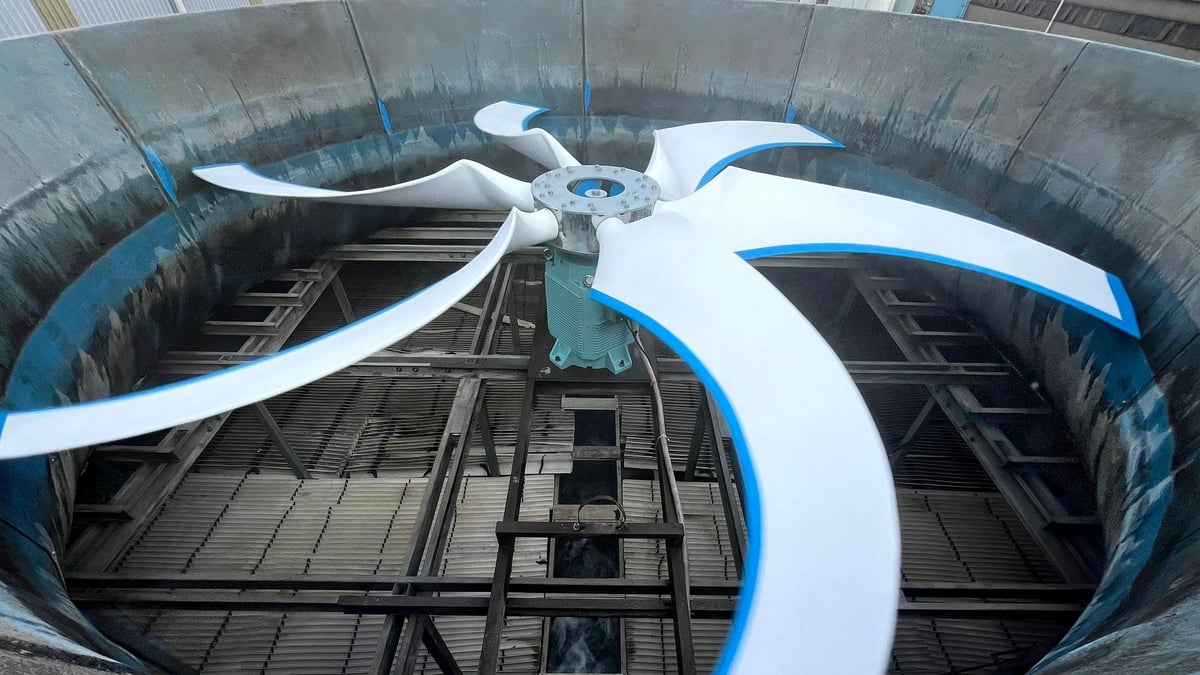
A direct drive PM motor like EMF's SQMC series replaces the entire drivetrain stack — motor, shaft, gearbox, couplings — with a single component. The fan mounts directly to the rotor. There is no intermediate mechanical stage.
The obvious question is: how? Conventional induction motors run at 1,200–1,800 rpm. Cooling tower fans need to spin at 150–250 rpm. That's what the gearbox was for.
The answer is pole count. EMF's SQMC motors use 66- and 88-pole rotor structures. At operating frequency, they run at fan-native speed without gear reduction. Induction motors can't do this efficiently because iron losses scale with frequency and the pole count needed would make them impractically large. PM motors can do it because the permanent magnets provide excitation without the copper losses that would otherwise dominate at high pole counts. The result is a motor that can run at 200 rpm with efficiencies up to 97% — something a conventional induction motor simply cannot deliver.
For US procurement, the key specifications:
| Specification | Value | US Relevance |
|---|---|---|
| Mounting | Flange / Foot | Compatible with standard CTI cooling tower mount patterns |
| Insulation Class | F | NEMA-compatible thermal headroom |
| Protection | IP65 | Exceeds NEMA 4/4X for outdoor tower duty |
| Vibration | A-level IEC 60034-14; optional sensor | Integrates with US predictive maintenance platforms |
| Ambient range | −10°C to +50°C (14°F to 122°F) | Covers Phoenix summer to Minneapolis winter |
| Thermal protection | 120°C PTO; PT100/PT1000/KTY/PTC optional | Compatible with most US BMS/SCADA systems |
| Voltage | 230 – 400 – 690 VAC | Maps to US 230/460/575V systems |
| Corrosion protection | C5VH (ISO 12944-2) | Appropriate for coastal and industrial environments |
| System efficiency | Up to 97% | vs. ~74–80% for conventional motor + gearbox + shaft |
4. Running the numbers — a data center cooling cell
Take a single colo data center cooling cell with a 110 kW (~150 hp) fan motor. AI workload variability keeps average load around 80%, but the tower runs 8,760 hours a year.
Conventional drivetrain
- System efficiency: ~75% (motor 93% × gearbox 92% × shaft/coupling 96% × coupling 96%)
- Annual consumption: 110 × 0.80 × 8,760 ÷ 0.75 ≈ 1,028,000 kWh/year
- At $0.128/kWh: ~$131,600/year per cell
EMF SQMC direct drive
- System efficiency: ~96–97%
- Annual consumption: 110 × 0.80 × 8,760 ÷ 0.96 ≈ 803,000 kWh/year
- At $0.128/kWh: ~$102,800/year per cell
Delta: ~225,000 kWh/year and ~$28,800/year per cell. For a 10-cell installation, that's 2.25 GWh and $288,000 annually — before counting eliminated gearbox maintenance, oil changes, and alignment service calls.
Payback at typical retrofit cost falls in the 18–30 month window for most US applications, after which the savings compound indefinitely. The 179D and Section 48 opportunities can pull that payback window in further depending on your project structure.
5. The retrofit — what the install actually looks like
The most common pushback I hear from US facility managers isn't about the economics. It's about downtime. 'We can't take that tower offline.' It's a fair concern, and it's one that direct drive retrofit is specifically engineered around.
The physical scope of a direct drive retrofit is narrower than most engineers expect:
- Fan blade pitch, plenum geometry, and basin all remain unchanged
- The motor + gearbox + shaft + couplings are replaced by a single motor assembly
- No structural redesign is required in the vast majority of installations
The electrical scope is similarly contained. In most US installations, the existing VFD continues to serve the new motor — SQMC motors support sensorless flux vector control, which is standard on virtually all modern industrial drives. No encoder is required in the vast majority of applications.
Typical installation timeline for a single-cell retrofit is one to three days, including crane access, mechanical removal, motor mounting, and electrical reconnection. Because no shaft alignment procedure is required after installation, commissioning time is significantly shorter than a conventional drivetrain replacement.
For multi-cell installations, cells can be sequenced to maintain partial cooling capacity throughout the upgrade — a critical consideration for data center operators who cannot take the cooling system offline simultaneously.
Ready to evaluate direct drive for your US facility?
EMF Motor's engineering team reviews your existing motor data, fan specifications, and operating profile — and provides a site-specific energy savings estimate at no charge.
Request a Technical Review →U.S. inquiries welcome · German engineering office: +49 6241 935 210