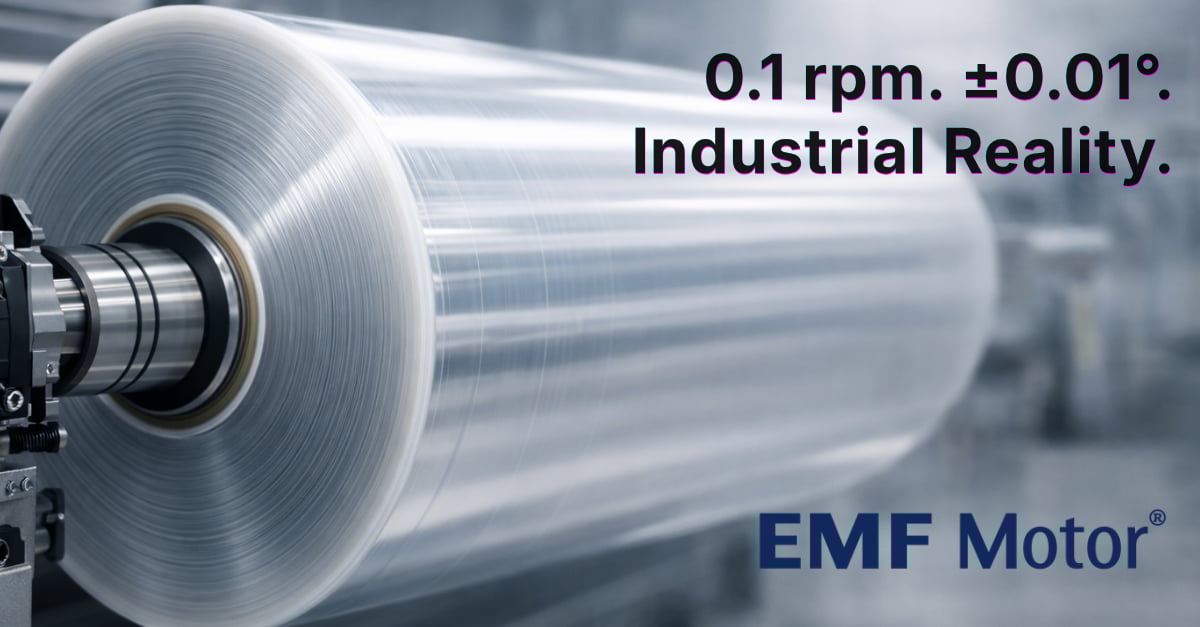
Ein Servomotor bei 0,1 U/min mit ±0,01° Positionsgenauigkeit.
Das ist kein Laborzustand.
Dies ist eine industrielle Wickellinie, die 24/7 arbeitet.
Und diese Unterscheidung zählt.
Denn bei Präzisionswicklungsanwendungen ist die höchste Leistungsanforderung nicht die hohe Geschwindigkeit — sie ist Stabilität bei extrem niedrigen Geschwindigkeiten.
Das Problem: Wo die meisten Motoren scheitern
In vielen industriellen Wicklungssystemen wählen die Ingenieure aufgrund der anfänglichen Kostenvorteile noch Standard-Wechselstrom-Induktionsmotoren aus.
Bei niedrigen Drehzahlen führen diese Motoren jedoch zu grundlegenden Einschränkungen:
- Instabile Drehmomentabgabe bei Nulldrehzahl
- Drehmomentwellen, die die Materialspannung beeinflussen
- Verzögerte dynamische Reaktion
- Uneinheitliche Geschwindigkeitsregelung
Diese Effekte sind nicht theoretisch. Sie übersetzen direkt in Produktionsfragen:
- Spannungsschwankungen über die Rolle
- Netzunterbrechungen und Materialabfälle
- Schichtveränderung
- Durchmesser Inkonsistenz im Endprodukt
Bei Wicklungsprozessen sammeln sich sogar kleine Abweichungen an.
Das Ergebnis: Qualitätsschwankungen und erhöhte Schrottmengen.
Warum Stabilität bei niedriger Drehzahl die Produktqualität bestimmt
Im Gegensatz zu vielen anderen Anwendungen arbeiten Wicklungssysteme über einen ständig wechselnden Zustand hinweg.
Am Anfang:
- Kleiner Durchmesser
- Geringe Trägheit
Am Ende:
- Großer Durchmesser
- Hohe Trägheit
Trotz dieser Veränderung muss das System konstante Spannung.
Dies ist nur möglich, wenn der Motor liefern kann:
- Stabiles Drehmoment aus Stillstand
- Sofortige Reaktion auf Laständerung
- Glatte Drehzahlregelung ohne Schwingung
Hier wird die Motortechnik entscheidend.
Der Vorteil von PMSM-Servomotoren
Permanent Magnet Synchronous Motors (PMSM), die in Servosystemen eingesetzt werden, sind speziell für die Präzisionssteuerung ausgelegt.
Konstantes Drehmoment ab 0 U/min
Ein PMSM Servomotor liefert konstantes Drehmoment aus dem Stillstand.
Es gibt keine unstabile Zone mit geringer Geschwindigkeit.
Dies gewährleistet:
- Leichter Start
- Keine Spannungsspitzen
- Konsistentes Wicklungsverhalten vom Kern bis zur Vollrolle
Integriertes Positionsfeedback
Servo-Systeme arbeiten mit Encoder-Feedback direkt an der Motorwelle.
Dies ermöglicht:
- Präzise Regelung im geschlossenen Regelkreis
- Genaue Positionierung in Traversensystemen
- Schichtweise Konsistenz
Bei hochpräzisen Anwendungen wird die Positionsgenauigkeit in Bruchteilen eines Millimeters gemessen.
Dynamische Kompensation in Echtzeit
Mit steigendem Rollendurchmesser ändert sich der Drehmomentbedarf kontinuierlich.
Ein Servoantrieb berechnet diese Veränderungen in Echtzeit.
Aber die Systemleistung hängt letztlich vom Motor ab, der Fähigkeit zu:
Liefern Sie das benötigte Drehmoment sofort und genau.
Ohne Verzögerung. Ohne Schwingung.
Der Motor ist nicht der Controller — aber er definiert das Ergebnis
In einem Servosystem:
- Der Antrieb berechnet
- Die Steuerung gibt Befehle
- Der Encoder misst
Der Motor führt die Bewegung aus.
Kann der Motor bei niedrigen Drehzahlen kein stabiles Drehmoment liefern,
Der gesamte Regelkreis verliert an Effektivität.
Daher ist die Wahl des Motors keine Zweitentscheidung.
Es ist ein Kerndeterminant der Prozessstabilität.
Wo dies in der Industrie zählt
Geringe Geschwindigkeitsgenauigkeit und stabiles Drehmoment sind entscheidend für:
- Folien- und Folienwicklung (Kunststoff, Verpackung)
- Draht- und Kabelspulenwicklung
- Aufwickeln von Carbonfaser-Rovings
- Textilgarne
- Spezialisierte Materialverarbeitung
In all diesen Anwendungen Die Produktqualität hängt von der Zugregelung ab.
Und die Zugsteuerung hängt von der Motorleistung ab.
EMF-Servomotoren: für Präzision bei niedriger Drehzahl entwickelt
EMF Servomotoren sind entwickelt, um zuverlässig bei extrem niedrigen Drehzahlen zu arbeiten und gleichzeitig eine hohe Drehmomentstabilität zu gewährleisten.
Hauptmerkmale sind:
- Stabiles Drehmoment auch bei sehr niedriger Drehzahl (bis zum nahezu Stillstand)
- Minimale Drehmomentwelligkeit für eine gleichmäßige Materialführung
- Hohe Steuerbarkeit mit fortgeschrittener Antriebskompatibilität
- Geringere mechanische Komplexität in Direktantriebskonfigurationen
Dies ermöglicht es Herstellern,
- Verbesserung der Produktkonsistenz
- Verringerung der Schrottmengen
- Prozesssicherheit erhöhen
- Dauerbetrieb stabil
Schlußfolgerung
In Präzisionswicklungsanwendungen wird die Leistung nicht durch maximale Geschwindigkeit definiert.
Es wird durch die Steuerung mit den niedrigsten Geschwindigkeiten definiert.
0,1 U/min. ±0,01°.
Das ist keine Spezifikation.
Das ist Produktionsrealität.
Besprechen Sie Ihre Wickelanwendung
Entdecken Sie die Servomotorlösungen von EMF Motor:
https://www.emfmotor.com/de/products/servo-motor
Senden Sie Ihre Anwendungsdaten - wir analysieren Ihr System und berechnen Leistungsverbesserungen.