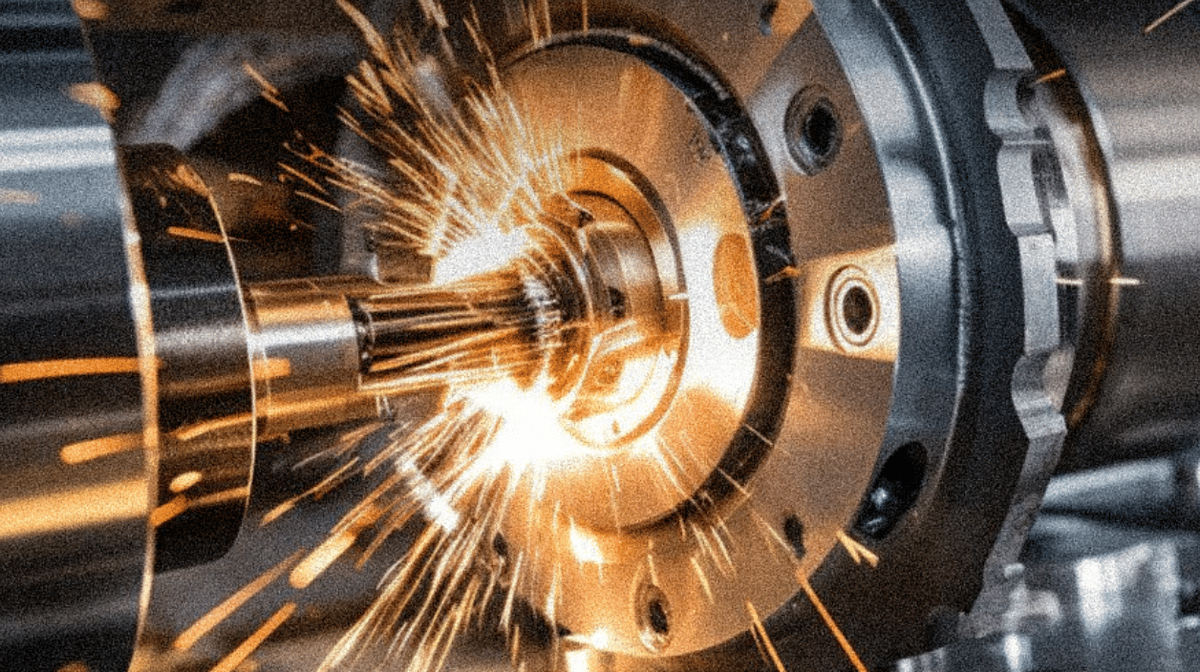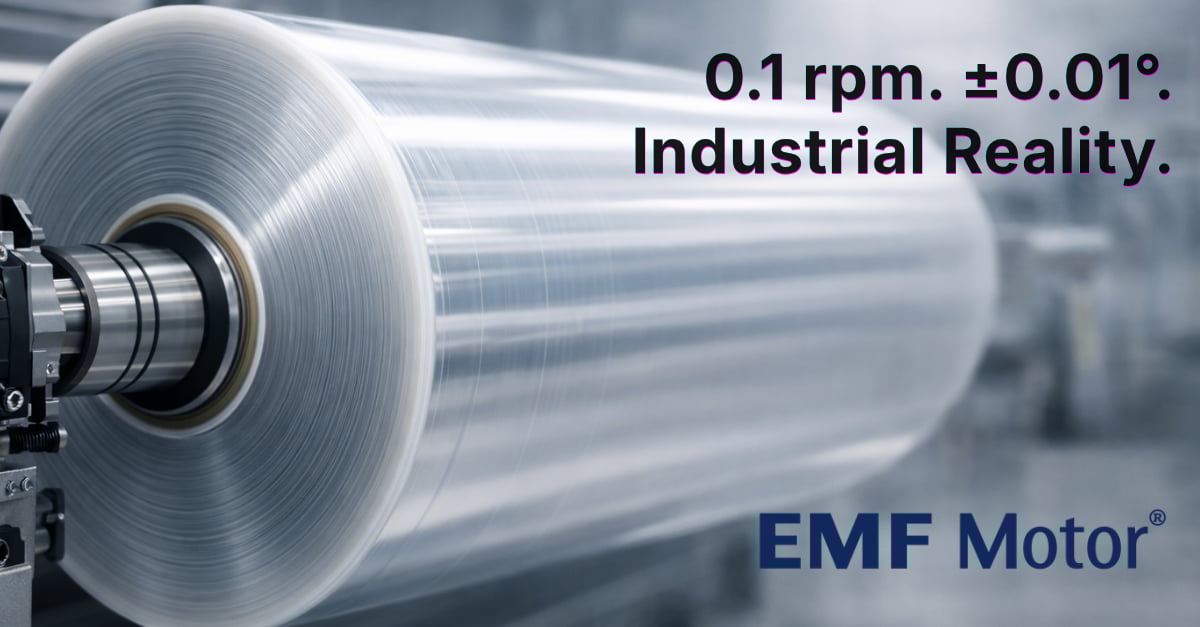
A servo motor running at 0.1 RPM with ±0.01° position accuracy.
This is not a laboratory condition.
This is an industrial winding line operating 24/7.
And that distinction matters.
Because in precision winding applications, the most critical performance requirement is not high speed — it is stability at extremely low speeds.
The Problem: Where Most Motors Fail
In many industrial winding systems, engineers still select standard AC induction motors due to initial cost advantages.
However, at low speeds, these motors introduce fundamental limitations:
- Unstable torque output near zero speed
- Torque ripple affecting material tension
- Delayed dynamic response
- Inconsistent speed regulation
These effects are not theoretical. They directly translate into production issues:
- Tension fluctuations across the roll
- Web breaks and material waste
- Layer misalignment
- Diameter inconsistency in the final product
In winding processes, even small deviations accumulate.
The result: quality variation and increased scrap rates.
Why Low-Speed Stability Defines Product Quality
Unlike many other applications, winding systems operate across a continuously changing condition.
At the start:
- Small diameter
- Low inertia
At the end:
- Large diameter
- High inertia
Despite this change, the system must maintain constant tension.
This is only possible if the motor can deliver:
- Stable torque from standstill
- Instant response to load variation
- Smooth speed control without oscillation
This is where motor technology becomes decisive.
The Advantage of PMSM Servo Motors
Permanent Magnet Synchronous Motors (PMSM), used in servo systems, are specifically designed for precision control.
Flat Torque from Zero RPM
A PMSM servo motor delivers consistent torque from standstill.
There is no “unstable zone” at low speed.
This ensures:
- Smooth startup
- No tension spikes
- Consistent winding behavior from core to full roll
Integrated Position Feedback
Servo systems operate with encoder feedback directly at the motor shaft.
This enables:
- Closed-loop precision control
- Accurate positioning in traverse systems
- Layer-by-layer consistency
In high-precision applications, positional accuracy is measured in fractions of a millimeter.
Real-Time Dynamic Compensation
As roll diameter increases, torque demand continuously changes.
A servo drive calculates these changes in real time.
But the system performance ultimately depends on the motor’s ability to:
Deliver the required torque instantly and accurately.
Without delay. Without oscillation.
The Motor Is Not the Controller — But It Defines the Result
In a servo system:
- The drive calculates
- The controller commands
- The encoder measures
But the motor executes.
If the motor cannot deliver stable torque at low speeds,
the entire control loop loses effectiveness.
This is why motor selection is not a secondary decision —
it is a core determinant of process stability.
Where This Matters in Industry
Low-speed precision and stable torque are critical in:
- Film and foil winding (plastics, packaging)
- Wire and cable spool winding
- Carbon fiber tow winding
- Textile yarn winding
- Specialty material processing
In all these applications, product quality depends on tension control.
And tension control depends on motor performance.
EMF Servo Motors: Designed for Low-Speed Precision
EMF servo motors are engineered to operate reliably at extremely low speeds while maintaining high torque stability.
Key characteristics include:
- Stable torque even at very low RPM (down to near standstill)
- Minimal torque ripple for consistent material handling
- High controllability with advanced drive compatibility
- Reduced mechanical complexity in direct drive configurations
This enables manufacturers to:
- Improve product consistency
- Reduce scrap rates
- Increase process reliability
- Achieve stable long-term operation
Conclusion
In precision winding applications, performance is not defined by maximum speed.
It is defined by control at the lowest speeds.
0.1 RPM. ±0.01°.
This is not a specification.
This is production reality.
Discuss Your Winding Application
👉 Explore EMF Servo Motor solutions:
https://www.emfmotor.com/en/products/servo-motor
👉 Send your application data — we analyze your system and calculate performance improvements.