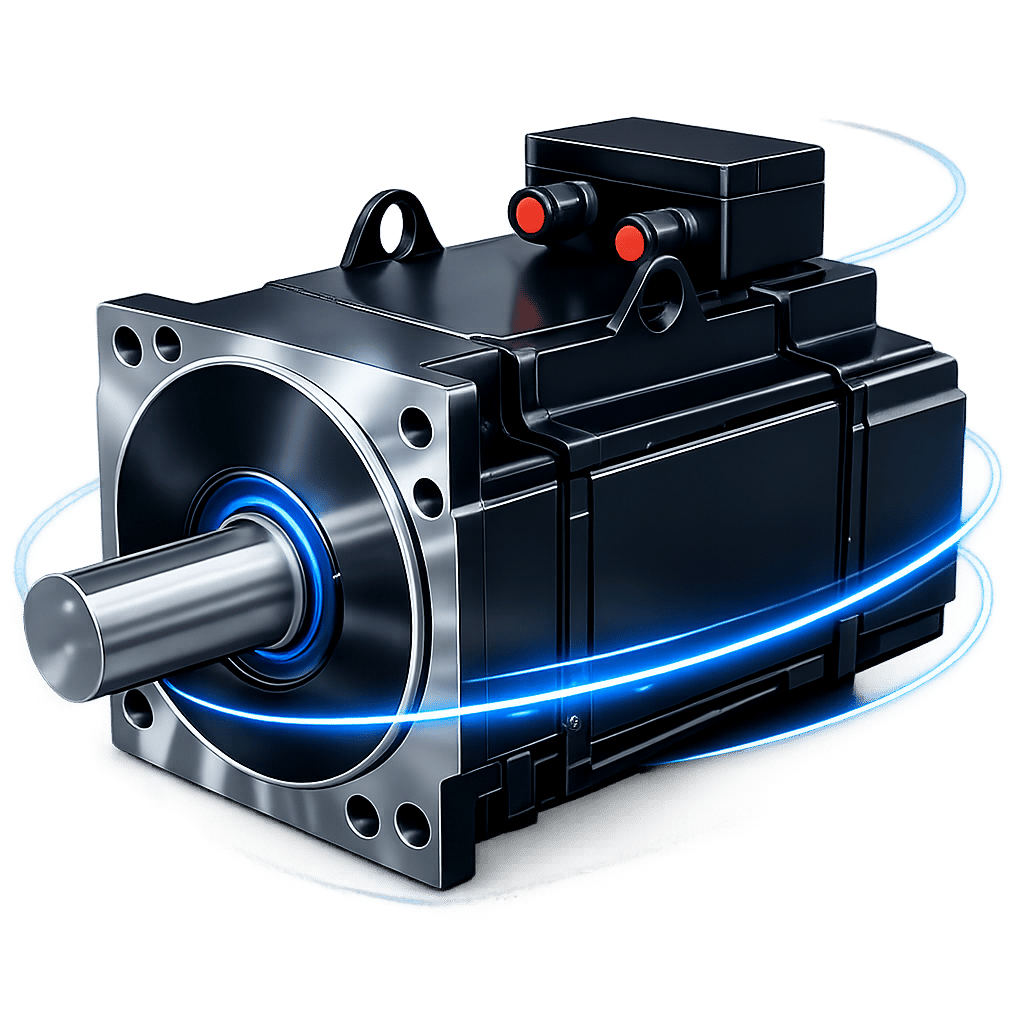
If you run a winding line, the drivetrain is one of your quietest cost centers — and one of the most expensive. Between a high-speed induction motor and the winding shaft sits a gearbox, a coupling, and on many lines a water-cooling circuit. Every one of those parts is doing two things at once: transmitting torque, and slowly draining money. The gearbox burns a few percent of your energy as heat on every rotation. The coolant loop has its own pump, its own pressure to monitor, and its own maintenance calendar. And as gears wear, the torque they pass through starts to fluctuate — which is exactly what a winder cannot tolerate.
This article is for the plant manager, operations lead, or technical decision-maker weighing whether a torque motor can take cost, complexity, and downtime out of that drivetrain. The short answer is yes, and the reason is structural, not incremental.
The problem: small torque fluctuations, large business losses
Winding and unwinding look simple from the outside and are unforgiving on the inside. The drive has to hold stable material tension while the roll diameter changes continuously, from an empty core up to a full roll, often down toward standstill. As EMF notes on its winder and unwinder application page, even small torque fluctuations can lead to wrinkles, film breaks, or uneven coil formation.
In business terms, those fluctuations are scrap, rework, and line stoppages. A conventional geared, water-cooled induction drivetrain works against you on three fronts at once:
- Energy leaks in the gearbox. Every gear mesh converts a slice of your input power into heat. That loss is paid on every meter of material, every shift, for the life of the line.
- The cooling loop is its own machine. A water-cooled drive adds a pump, hoses, a heat exchanger or chiller, coolant to top up and treat, and pressure and leak points to inspect — energy and maintenance that have nothing to do with making product.
- Wear degrades the very thing you are controlling. Backlash and gear wear introduce torque ripple over time, and that ripple prints straight into web tension and roll quality.
The result is a drivetrain that costs more to power, more to maintain, and more to keep precise — three line items that compound year after year.
The solution: a gearless, water-cooling-free direct drive
EMF Motor's answer is to remove the chain instead of optimizing it. The SQM torque motor is a permanent-magnet synchronous motor that delivers high torque directly at low speed. The rotor couples straight to the winding shaft — no gearbox, no coupling, and no water-cooling circuit on the drive. Three components collapse into one.
That single design decision is what makes a gearless torque motor to replace a winder gearbox practical rather than theoretical. The high pole count — 66, 88, or 110 poles — is what lets the motor turn slowly while still producing large torque, so the winding shaft gets the torque it needs with no mechanical reduction in the way.
The specifications that matter to a winding line:
- Full torque across the full speed range — a near-empty core and a full roll are both held at the tension you set, with high efficiency even at 0.1 rpm.
- Convection cooling (IC410) — no water cooling required.
- IE5 efficiency class, with rated efficiencies in the mid-90s, up to about 95.7 percent in the catalogue tables.
- Torque envelope up to 13,000 Nm with the blower kit — torque sized to the winding shaft demand with no reduction stage in the way.
- High overload capacity for the transients of starts, splices, and acceleration.
- Enclosed and robust — IP54 standard, with IP55, IP65 and Exproof options.
Because the drive is direct, the line can run without load cells or dancers for tension feedback in many configurations — fewer sensors and mechanical assemblies to buy, install, and maintain.
What you actually remove from the machine
The water-cooling-free advantage is worth spelling out, because it is more than one less hose. Dropping the cooling loop removes an entire subsystem:
- No cooling circuit — no pump, no heat exchanger or chiller, no associated electrical load running whenever the line runs.
- No coolant maintenance — nothing to top up, treat, test for contamination, or dispose of, and no freeze or corrosion risk to manage.
- Simpler installation — no plumbing to route, pressure-test, and commission. The motor mounts by flange or foot directly where the torque is needed.
Off the bill of materials and the maintenance schedule, in parallel, go the gearbox (and its oil, seals, and service interval) and the coupling or belt with its alignment and tensioning work. What remains is a single enclosed motor doing the job that three subsystems used to do.
How EMF differs from the conventional drivetrain
The comparison that matters here is not against another brand — it is against the category most winding lines run today: a conventional geared, water-cooled induction drivetrain. Measured against that category, the EMF direct-drive torque motor differs on four structural points:
| Dimension | Conventional geared, water-cooled induction drivetrain | EMF SQM direct-drive torque motor |
|---|---|---|
| Power transmission | Gearbox plus coupling between motor and shaft | Gearless — rotor couples directly to the shaft |
| Cooling | Water-cooling circuit (pump, lines, coolant) | Convection cooling (IC410), no water required |
| Efficiency class | Typically below IE5 | IE5, tables up to about 95.7 percent |
| Low-speed torque | Falls off or needs reduction to hold torque | Full torque across the full speed range, down to near standstill |
Conventional-side characteristics describe the general category, not any named manufacturer.
The result: where the savings come from
Decision-makers want the money line. The strongest grounded proof EMF publishes is a direct, size-for-size comparison on its winder and unwinder page:
A 19 kW servo motor with a gearbox can be replaced by a 4 kW EMF motor delivering the same output torque.
Same torque at the shaft, less than a quarter of the installed motor power. That is the headline of the value story — a published EMF capability example, not a named customer project or an estimate. The gap is not a single efficiency trick. It is what happens when direct drive designs out the transmission losses and the oversizing that a geared servo train builds in.
Why the gap exists — the mechanism. Three effects stack:
- No gearbox transmission losses. Removing the gear stage removes the share of input power it converted to heat on every rotation. With the motor coupled directly to the shaft, the efficiency you measure at the shaft is the efficiency the load receives.
- No cooling-system energy. A convection-cooled motor has no pump or chiller drawing power whenever the line runs.
- IE5 motor efficiency. The motor itself converts electrical input to shaft torque in the mid-90s percent range, up to about 95.7 percent, the highest IEC efficiency tier.
Stacked together — no gear loss, no cooling load, IE5 conversion — those mechanisms are what let a 4 kW direct drive do the work of a 19 kW geared servo. EMF does not publish a single energy-savings percentage for the winder application, so neither do we: the exact figure depends on your line, and the magnitude is shown by the 19 kW to 4 kW example rather than a generic claim.
Where a hard ROI number needs real data. A specific payback period, annual saving, or ROI percentage depends on your line duty cycle, energy price, run hours, and the drivetrain being replaced — inputs only your facility data can supply. An honest ROI for your line comes from your numbers run against the motor rated efficiency, not from a generic claim. EMF's engineering team can build that calculation with you.
Beyond energy, the same direct-drive design reduces maintenance (no gear oil, no coolant, fewer wear parts) and protects product quality by holding tension without gear-induced ripple — the scrap and downtime side of the ledger that often outweighs the energy line itself.
Is a torque motor right for your line?
A direct-drive torque motor earns its place wherever the duty is high torque at low and variable speed: winders, unwinders, and recoilers across plastic film, paper converting, metal coil, textile, cable, and battery-foil lines. If your line is specifically an extrusion process, the EMF extruder motor page covers the same gearless, water-cooling-free configuration for the screw.
Take the next step
If a conventional geared, water-cooled drivetrain is costing you energy, maintenance hours, and tension quality on a winding line, the direct-drive path is worth a serious look. Here is a concrete next step for a decision-maker:
- Pull one winding line drivetrain detail — installed motor power, gearbox, cooling type, run hours, and energy rate.
- Review the EMF torque motor product page and the winder and unwinder application page to match a frame size, pole count, and torque rating to that line.
- Contact the EMF engineering team with those figures and ask for a direct-drive sizing and an energy comparison built on your data.
You replace three subsystems with one, take a measurable bite out of your energy bill, and remove a maintenance calendar — backed by EMF's grounded specifications, not estimates.