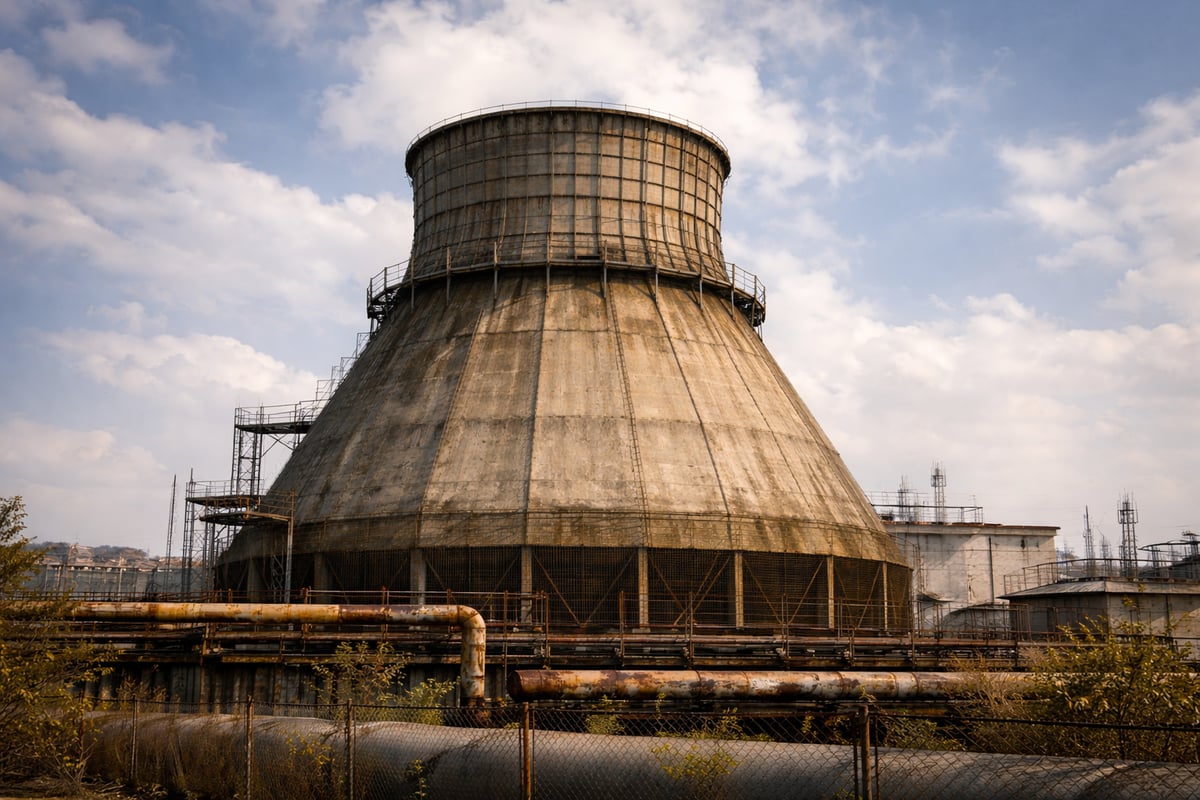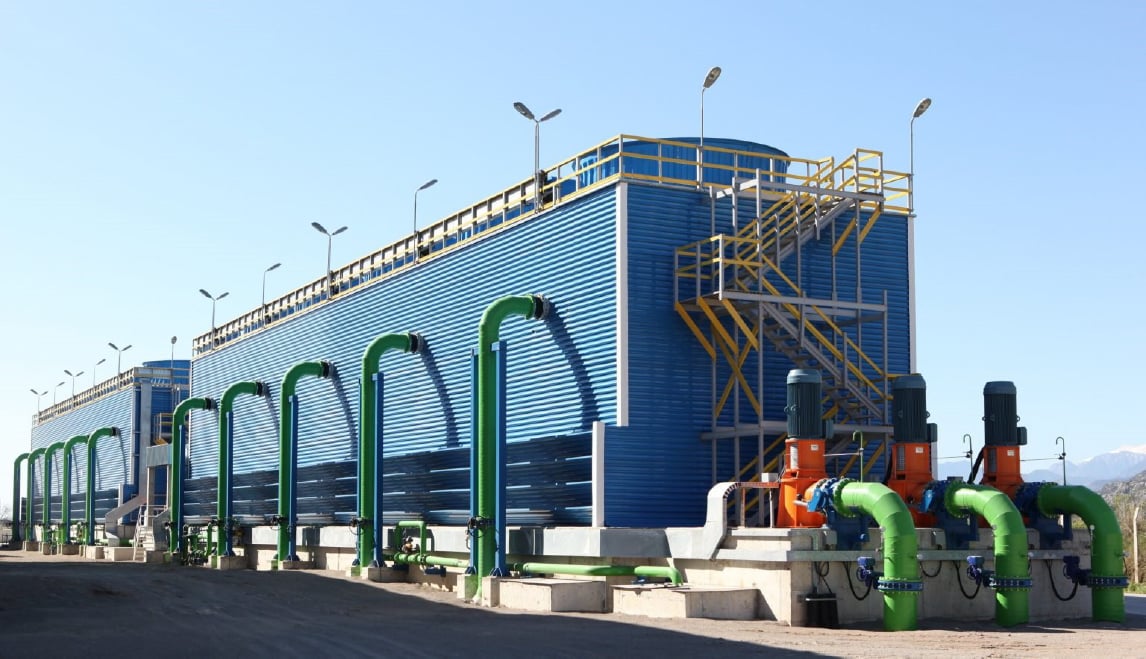
A cooling tower fan may turn at only a few hundred revolutions per minute, but it does so for thousands of hours a year. That combination — low speed, high torque and continuous exposure to warm, humid air — is exactly where a conventional motor, long shaft and right-angle gearbox become expensive to live with.
Replacing that drivetrain with a direct drive motor sounds simple. Mechanically, it can be. Specifying the motor correctly is the part that deserves care. The nameplate power of the existing induction motor is useful, but it is not enough. Fan speed, required shaft torque, starting inertia, airflow over the motor, VFD capability and the existing fan-hub geometry all affect the final selection.
This guide explains the checks engineers should complete before selecting a direct drive cooling tower motor, using the EMF SQMC series as a working reference.
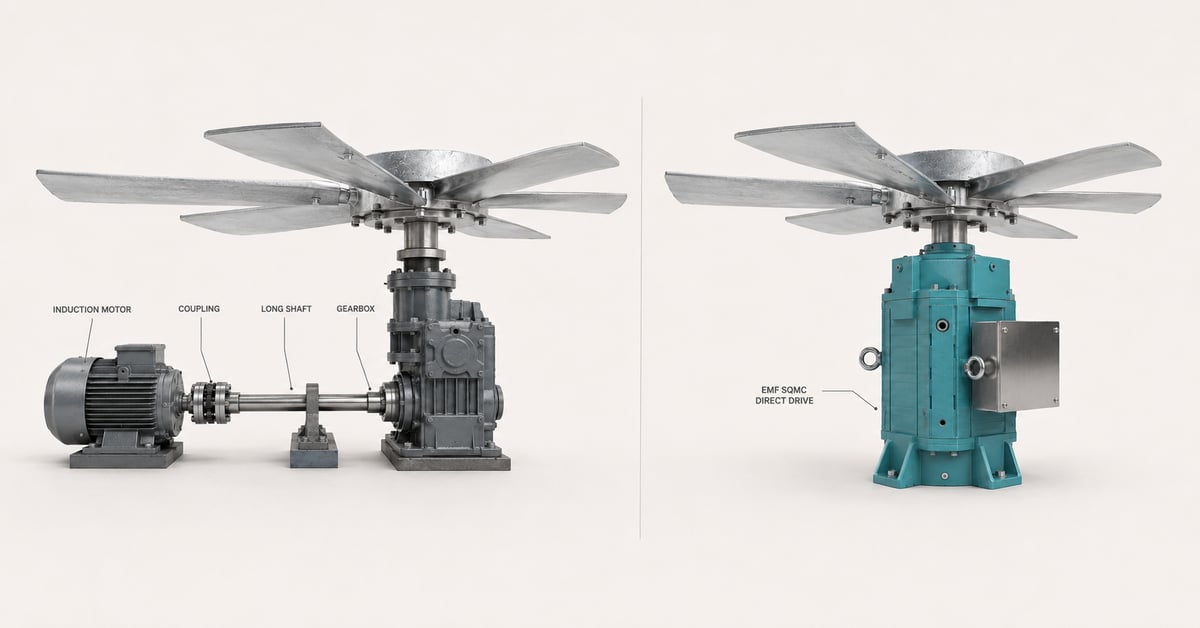
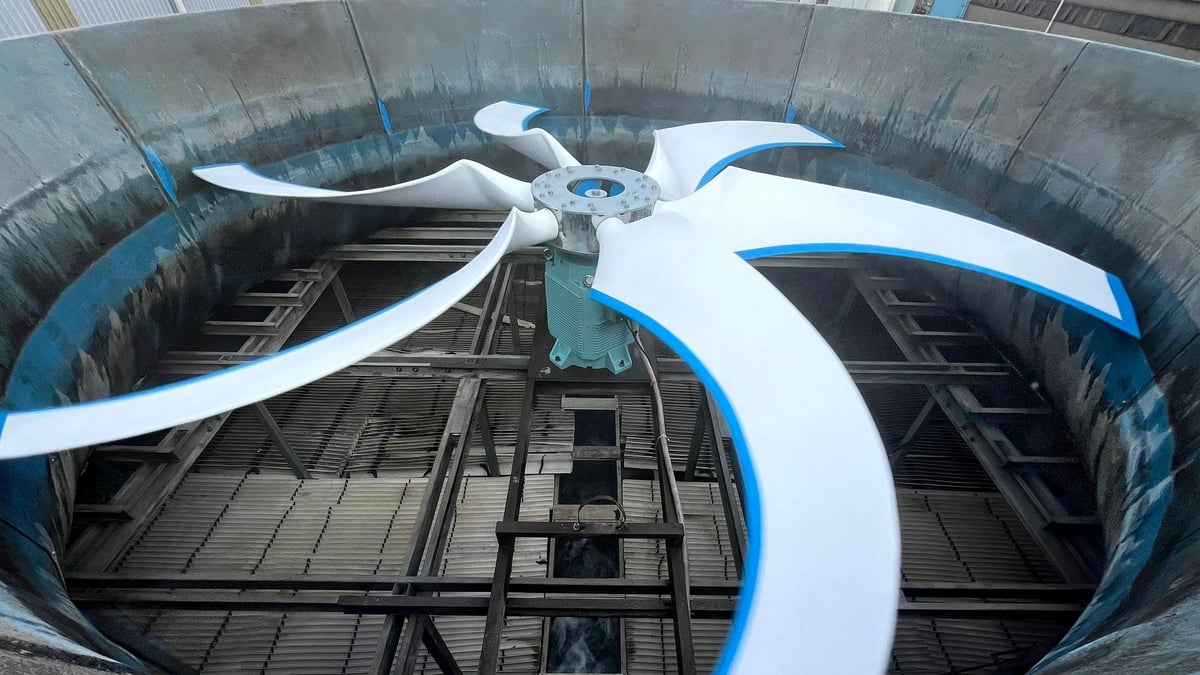
The drivetrain you are replacing: induction motor, coupling, long shaft and gearbox versus a single SQMC motor at the fan hub.
Start with the fan — not the existing motor nameplate
The most reliable selection begins at the fan shaft. Two operating values matter first: the required fan speed and the torque at that speed. Rated power follows from those values; it should not be the only input.
For rotational systems:
Power (kW) = Torque (Nm) × Speed (rpm) / 9,550
If a fan requires 1,700 Nm at 200 rpm, its mechanical power at the operating point is approximately 35.6 kW. In the current SQMC catalogue, that duty point corresponds to the SQMC200-500. The calculation is straightforward; the engineering judgment lies in confirming that 1,700 Nm is the real continuous requirement and that acceleration, blade pitch and site conditions have been allowed for.
Five inputs that determine the motor selection
- Fan operating speed: Use the normal operating range, not only the maximum permissible speed.
- Continuous shaft torque: Obtain it from the fan manufacturer or calculate it from verified shaft power and speed.
- Starting and acceleration requirement: Large fan assemblies have significant inertia. Agree the acceleration time and available current with the VFD supplier.
- Ambient and installation conditions: Check temperature, altitude, humidity, corrosion exposure and the actual airflow around the motor.
- Mechanical interface: Confirm shaft, flange or foot mounting, fan-hub connection, axial load and structural support before release to manufacture.
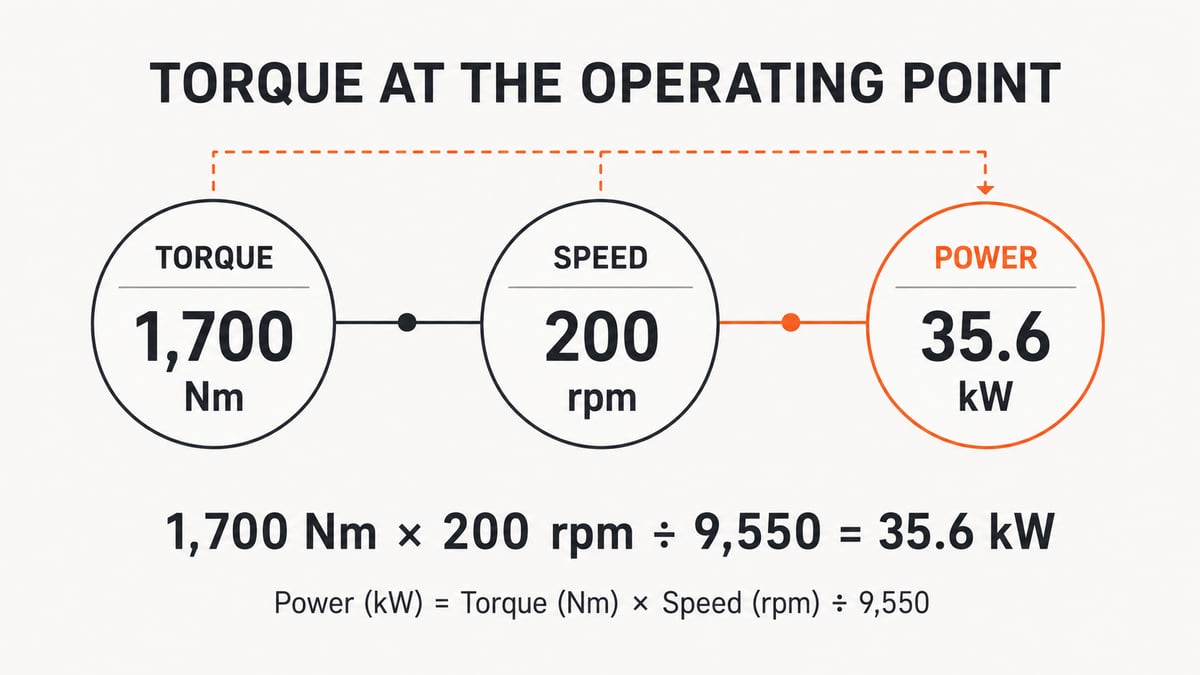
Torque at the operating point: 1,700 Nm × 200 rpm ÷ 9,550 = 35.6 kW.
What direct drive changes
A conventional induced-draft cooling tower commonly uses a high-speed induction motor outside the air stream, a coupling, a long drive shaft and a right-angle gearbox at the fan. Every interface brings alignment, lubrication, sealing or inspection work. Direct drive removes the transmission and places a low-speed, high-torque permanent-magnet motor at the fan.
The important point is not simply that fewer parts remain. The motor is designed to run at fan speed. With 66 or 88 poles in the SQMC range, torque is produced without first running at roughly 1,500 rpm and then reducing speed mechanically.
| Conventional drivetrain | Direct drive SQMC |
|---|---|
| Induction motor + coupling + long shaft + gearbox | High-pole PM motor connected directly to the fan |
| Gearbox oil, seals and coupling elements require inspection | No gearbox oil, long shaft or coupling elements |
| Multiple alignment points | Fan and motor share one shaft interface |
| Efficiency depends on every component in the chain | Motor efficiency is effectively drivetrain efficiency |
| Transmission components occupy the fan-deck area | Compact package at the fan hub |
SQMC performance range: read the table by torque and speed
The following 200 rpm catalogue points show why two motors with similar frame sizes should not be compared by kilowatts alone. Confirm the latest catalogue and project-specific datasheet before ordering.
| Motor code | Poles | Power | Speed | Torque | Efficiency |
|---|---|---|---|---|---|
| SQMC132-150 | 66 | 6.5 kW | 200 rpm | 310 Nm | 94.5% |
| SQMC132-300 | 66 | 12.4 kW | 200 rpm | 590 Nm | 96.0% |
| SQMC200-300 | 88 | 23.0 kW | 200 rpm | 1,100 Nm | 93.5% |
| SQMC200-500 | 88 | 35.6 kW | 200 rpm | 1,700 Nm | 94.5% |
| SQMC250-400 | 88 | 48.2 kW | 200 rpm | 2,300 Nm | 95.0% |
| SQMC250-600 | 88 | 71.2 kW | 200 rpm | 3,400 Nm | 95.5% |
Reference basis: EMF Cooling Tower Motor Catalogue CT0125EN001. Catalogue values must be checked against the required operating point and order-specific configuration.
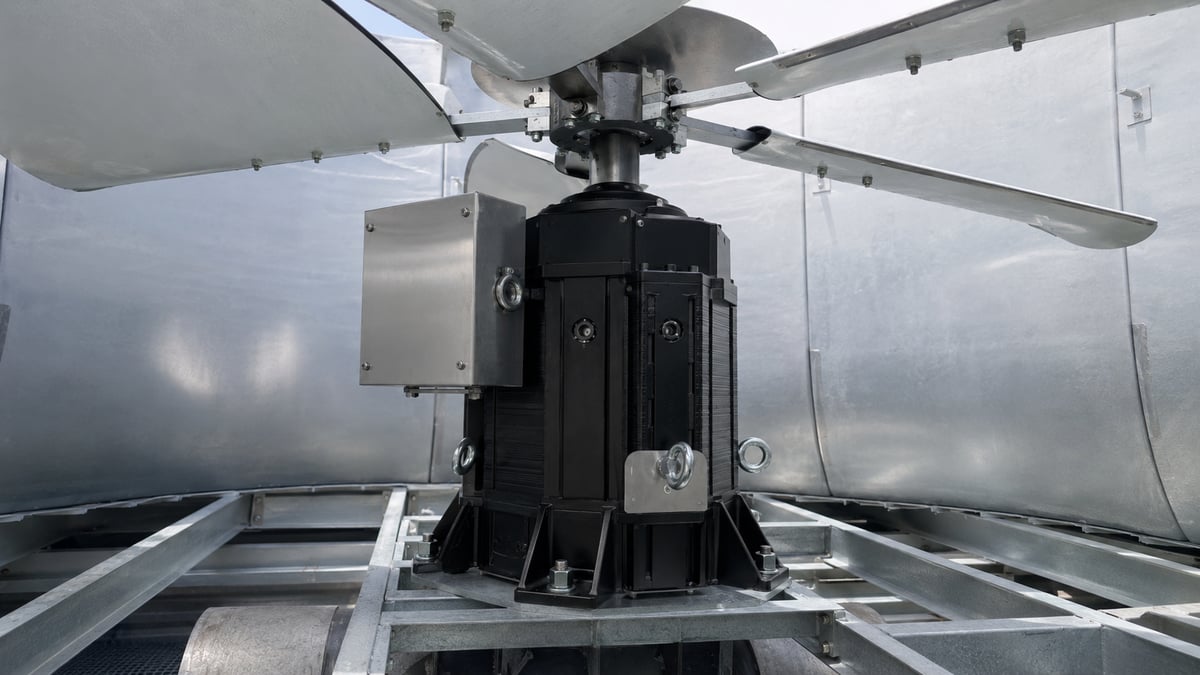
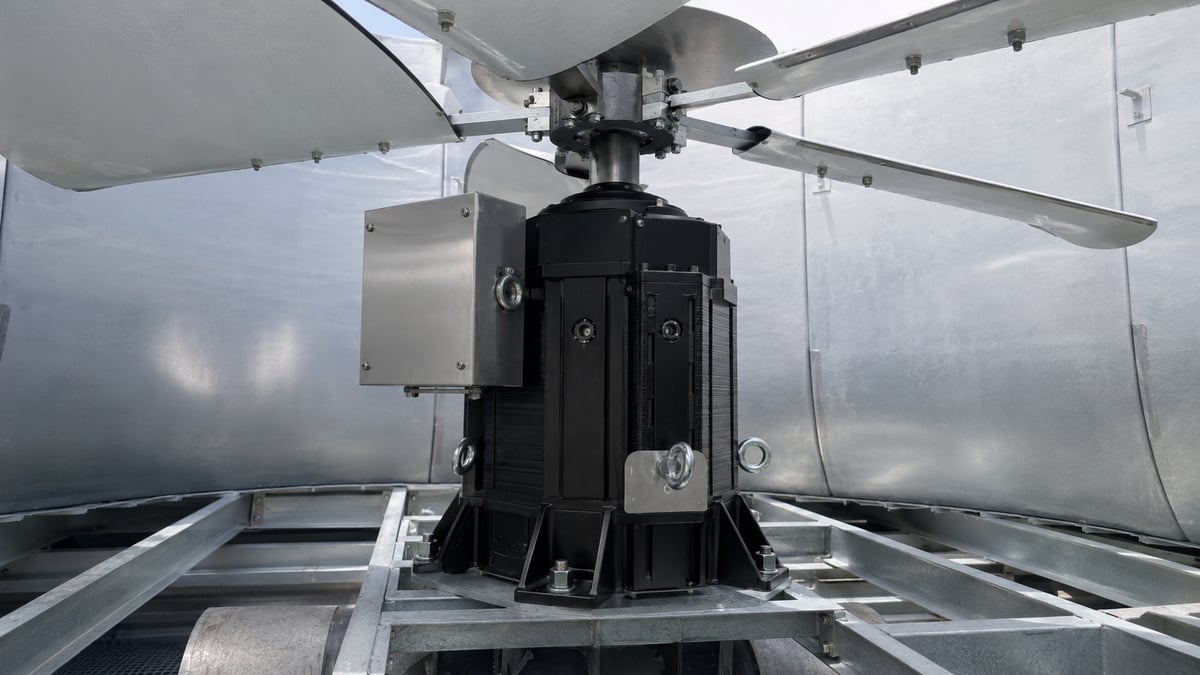
An EMF SQMC motor mounted directly beneath a cooling tower fan hub.
VFD control is part of the motor selection
A permanent-magnet direct drive cooling tower motor requires an inverter; it is not a direct-on-line replacement for an induction motor. Confirm that the selected VFD supports PM-motor control and that the commissioning team can enter the motor data and complete the required identification or tuning routine.
Sensorless flux-vector control is attractive in a cooling tower because it avoids an encoder and feedback cable at the fan deck. That does not mean the drive can be chosen generically. Check current rating, switching strategy, cable length, protection settings, acceleration time and the motor manufacturer's commissioning data as one package.
Why variable speed matters
Cooling demand changes with wet-bulb temperature and process load. For geometrically similar fan operation, the fan affinity laws indicate that airflow varies approximately with speed, pressure with the square of speed and power with the cube of speed. In practical terms, a modest speed reduction can produce a much larger reduction in fan power. Actual site savings depend on the operating profile, control strategy, fan condition and the efficiency of the system being replaced; they should be modelled from measured duty data rather than promised as a universal percentage.
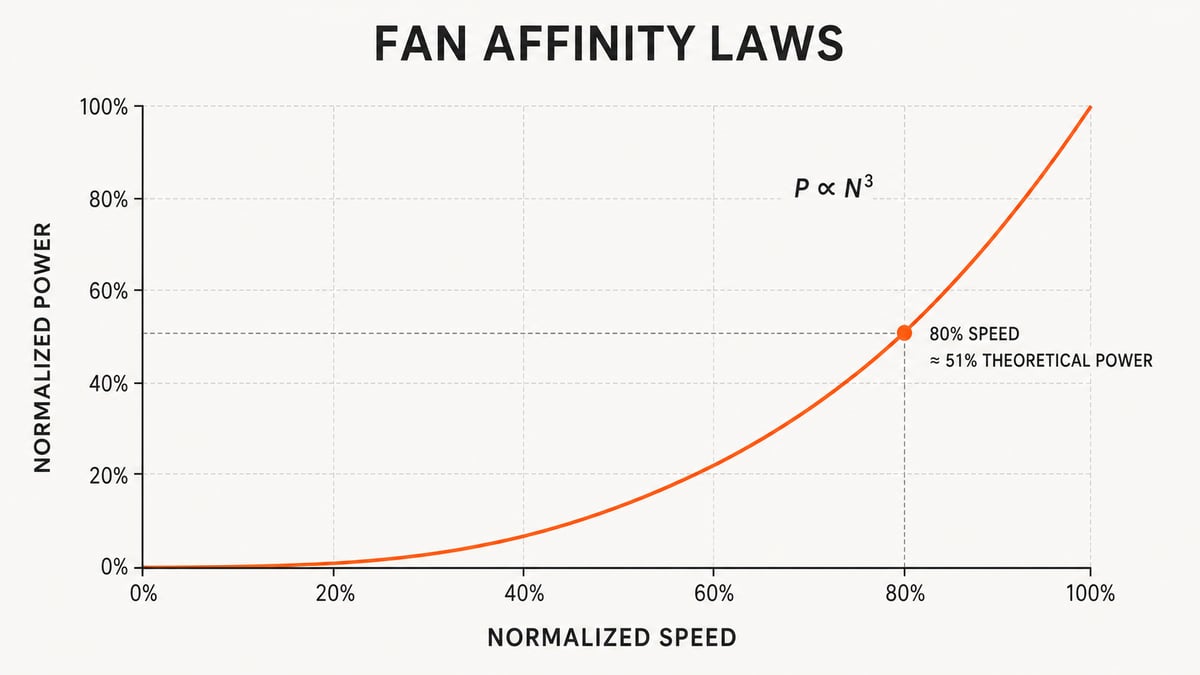
Fan affinity laws: at 80% speed, theoretical power is approximately 51% of full-speed power.
Can the existing cooling tower be retrofitted?
Often, yes — but "retrofit-ready" should never be interpreted as "dimension-check optional." Removing the old drivetrain changes both the equipment layout and the loads carried by the tower structure. A site survey should settle the following points before a motor is selected:
- Available space at the fan hub and access for lifting the new motor.
- Fan-hub bore, shaft diameter, key or locking arrangement and mounting tolerances.
- Required flange or foot-mounting arrangement and the condition of the support structure.
- Fan weight, axial thrust and any external radial loads transmitted to the bearings.
- Cable route, VFD location, earthing and protection requirements.
- Air velocity over the motor throughout the intended speed range.
- Whether fan balancing, blade-pitch correction or structural repair should be completed at the same shutdown.
Installation time therefore varies by tower design, access and structural scope. A precise shutdown plan should follow the site survey; a universal one- or two-day promise is not a sound basis for procurement.
Environmental protection: read every rating separately
Cooling towers combine water, humidity, treatment chemicals and, in some locations, salt-laden air. The ingress rating, coating system and thermal design address different risks and should not be treated as interchangeable labels.
| Specification | SQMC catalogue reference | What to verify on the project |
|---|---|---|
| Ingress protection | IP65 | Spray exposure, cleaning method, cable glands and terminal-box orientation |
| Corrosion protection | C5VH coating system | Site corrosivity, chemical exposure, surface preparation and requested durability system |
| Cooling | IC 410 natural cooling | Required airflow over the motor; catalogue reference states at least 3 m/s |
| Ambient range | –10 °C to +50 °C | Actual maximum temperature and any solar or process heat |
| Altitude | Reference values up to 1,000 m | Apply project-specific derating above the reference altitude |
| Thermal protection | 120 °C PTO standard; sensor options available | Match PTO/RTD/PTC signals to the VFD or plant control system |
Maintenance changes; it does not disappear
Direct drive eliminates the gearbox oil circuit, long-shaft alignment and flexible coupling elements. That is a meaningful reduction in planned work at height. The remaining equipment still deserves a defined inspection routine: electrical connections, mounting fasteners, bearing condition, corrosion, fan balance, vibration trend and cooling airflow.
This distinction matters. "No gearbox maintenance" is precise and defensible. "Maintenance-free cooling tower" is not.
A procurement checklist engineers can actually use
- State the required continuous torque and operating-speed range.
- Provide fan inertia, blade data and the requested acceleration time.
- Confirm axial thrust, external loads and fan-hub interface dimensions.
- Record ambient temperature, altitude, airflow and corrosive exposure.
- Choose mounting form and agree the structural interface drawing.
- Select a PM-compatible VFD by current and control capability — not only by kW.
- Define thermal and vibration signals required by the plant control system.
- Request a project datasheet, efficiency curve, dimensional drawing and commissioning parameters.
- Compare lifecycle work and measured annual energy — not purchase price alone.
Common questions
Does a direct drive cooling tower motor need a gearbox?
No. The high-pole permanent-magnet motor is designed to produce the required torque at fan speed, so a speed-reduction gearbox is not needed.
Can it run directly from the mains?
No. A PMSM direct drive motor requires a compatible VFD. Direct-on-line starting is not appropriate.
Can an existing cooling tower use direct drive?
Many can. The decision depends on fan duty, hub geometry, axial load, structure, access and electrical integration. A site survey should precede final selection.
Is IP65 enough for every cooling tower?
IP65 addresses ingress protection. Corrosion category, coating durability, chemical exposure, cable entries and maintenance method must also be specified.
How much energy will it save?
There is no single percentage for every tower. Savings come from removing transmission losses and, where the operating profile allows it, controlling fan speed. The credible estimate uses measured baseline power and annual operating hours.
Does sensorless control mean no commissioning is needed?
No. It removes the encoder, not the commissioning work. The VFD still needs the correct motor data, protection limits and control tuning.
The decision in one sentence
Choose a direct drive cooling tower motor from the fan's real torque and speed requirement, then verify the mechanical interface, environment and VFD as one engineered system.
For full SQMC curves, dimensional drawings and available options, visit the EMF Cooling Tower Motor product page. For a lifecycle-cost discussion of the conventional drivetrain, see Why the Gearbox Is the Biggest Hidden Cost in Your Cooling Tower.
Talk to EMF Application Engineering
Send your fan's torque, speed and site conditions and the EMF application engineering team will confirm the right SQMC model, VFD pairing and mechanical interface for your tower.
Contact: info@emfmotor.com · www.emfmotor.com