The bottle on your production line does not care what motor is installed on the machine.
What determines product quality is the parison. If the parison wall thickness varies, the finished part will vary. If screw speed fluctuates, wall thickness fluctuates. If torque delivery is inconsistent, scrap increases. In blow molding, product quality is often decided long before air enters the mold.
This is why more machine builders and processors are re-evaluating the drivetrain behind the extruder screw.
Traditional blow molding systems typically rely on a combination of an AC motor, gearbox, hydraulic system and belt or chain transmission. The architecture is familiar and proven, but it also introduces torque ripple, mechanical losses, maintenance requirements and unnecessary energy consumption.
Direct drive technology approaches the problem differently. Instead of compensating for drivetrain limitations, it removes the components that create them.
For plant managers, machine builders and engineering teams looking to improve parison thickness control, reduce scrap and lower operating costs, the question is no longer whether direct drive works. The question is whether the benefits justify replacing the conventional drivetrain.
EMF Motor published blow molding application data.
Parison Thickness Control Starts at the Screw
Every rotation of the extruder screw influences the parison.
When rotational speed varies, even slightly, the polymer flow changes. Those changes appear as wall thickness variation, inconsistent weight distribution and increased process instability.
On conventional blow molding machines, several factors contribute to these variations:
- Gearbox backlash and gear mesh irregularities
- Motor cogging effects at low speed
- Reduced control stiffness during slow-speed operation
- Hydraulic pressure fluctuations in accumulator systems
The result is parison thickness variation that operators often compensate for by adding material, widening tolerances or increasing scrap allowances.
The hidden cost is not only wasted polymer. It is reduced process capability.
Why Direct Drive Technology Improves Wall Thickness Accuracy
A direct drive blow molding motor eliminates the gearbox, hydraulic transmission components and mechanical reduction stages. The motor is connected directly to the screw. This changes the behavior of the entire extrusion process.
Without gears, there is no gear mesh ripple. Without backlash, there is no lost motion. Without hydraulic losses, more input energy reaches the process. The result is smoother screw rotation and more stable polymer flow.
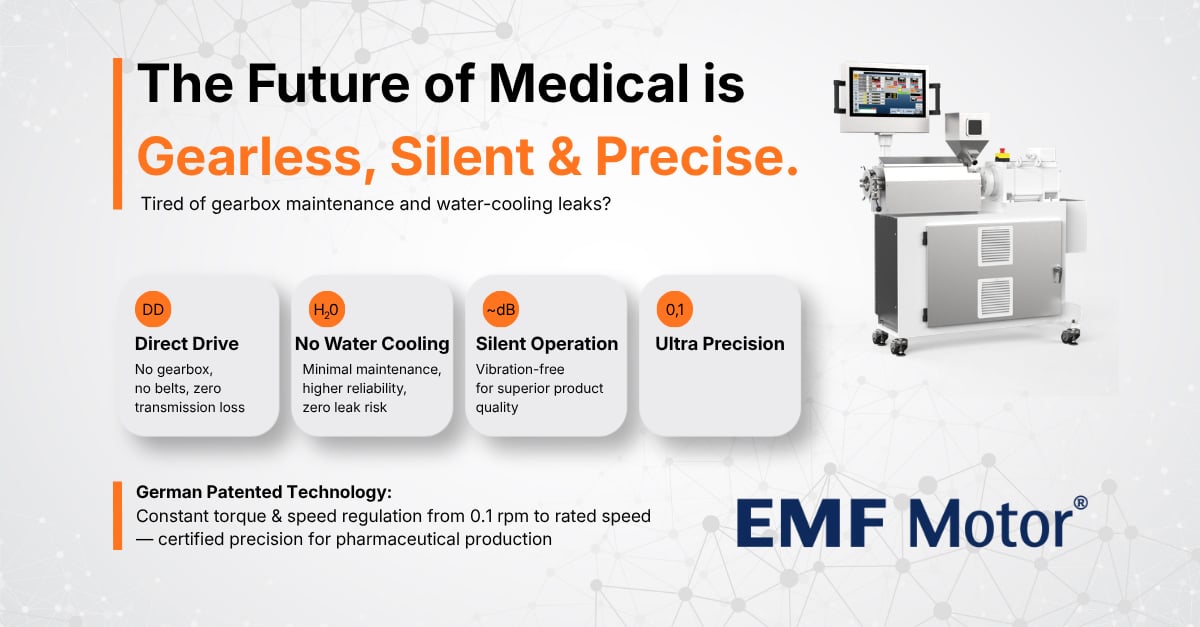
According to EMF Motor's published blow molding application data, direct drive technology can achieve ±2% parison wall thickness accuracy, full rated torque from 0 RPM, speed accuracy within ±0.05%, up to 30% lower energy consumption and up to 97% motor efficiency.
For applications where wall thickness consistency directly affects product quality, these improvements can have a measurable impact on both scrap rates and production stability.
Why Zero Cogging Matters
Most discussions about motors focus on power. Blow molding applications are different. The real challenge is maintaining precise control at very low speeds, and this is where conventional motors often struggle.
As rotor position changes, torque output can rise and fall slightly. This phenomenon, known as cogging, becomes more noticeable at low speed and can introduce small disturbances into screw rotation. In parison programming applications, those disturbances eventually appear in the polymer.
EMF's fractional-slot winding design is intended to eliminate this effect by delivering exceptionally smooth torque throughout the operating range.
More stable screw rotation. More stable parison formation. More consistent wall thickness.
Accumulator Head Applications Demand Full Torque at Zero Speed
Accumulator head machines place unique demands on the drivetrain. The screw may need to rotate extremely slowly while maintaining high torque, and during filling and discharge cycles, torque requirements can change rapidly.
A conventional drivetrain often relies on a combination of gearbox multiplication and hydraulic assistance to achieve these operating conditions. A direct drive permanent magnet motor approaches the problem differently: high torque is available directly from the motor shaft, even at standstill.
This allows precise control throughout the entire filling and discharge cycle without the mechanical complexity of gearboxes or hydraulic systems.
Where Direct Drive Delivers the Greatest Value
Direct drive technology is particularly effective in:
Multi-layer applications deserve special attention. When several extruders feed different material layers into the same product, maintaining consistent output from each layer becomes critical. Small variations in one layer can affect the entire structure of the finished part.
The more demanding the thickness profile, the greater the value of stable screw control.
Direct Drive vs Conventional Blow Molding Drivetrains
Instead of comparing brands, it is more useful to compare drivetrain architectures.
By eliminating intermediate components, direct drive systems reduce transmission losses, simplify maintenance and improve control accuracy.
For many processors, the biggest advantage is not energy savings. It is process stability.
What Creates the 30% Energy Reduction?
Energy savings do not come from a single improvement. They come from removing multiple sources of loss. In a conventional system:
- Gearboxes generate friction losses
- Hydraulic systems consume pump power
- Oil cooling systems consume additional energy
- Multiple transmission stages reduce overall efficiency
A direct drive motor removes these losses from the drivetrain. As operating hours increase, the annual savings become increasingly significant. Facilities running high-volume blow molding production often see the greatest economic benefit because the energy reduction accumulates every hour the line operates.
Can Existing Machines Be Retrofitted?
One common misconception is that direct drive technology requires a new machine. In reality, many blow molding machines can be retrofitted.
The existing motor, gearbox, hydraulic drive components and transmission elements are removed and replaced with a single direct drive motor. For many machine configurations, the retrofit can be completed with minimal structural modification.
This makes direct drive a practical modernization option rather than a greenfield-only solution.
Calculate Your Blow Molding Energy Savings
Every production line is different. The most accurate way to evaluate direct drive technology is to compare it against your existing machine.
- Installed motor power (kW)
- Screw speed range (RPM)
- Annual operating hours
- Current gearbox ratio
- Estimated energy savings
- Direct drive motor sizing
- Retrofit feasibility review
- Expected payback period
Send your figures to the EMF engineering team →
The results are based on your machine, your operating hours and your production conditions—not generic industry assumptions.
Because in blow molding, improving wall thickness control is not only a quality decision. It is an energy, maintenance and profitability decision.