How Does an Extruder Work?

A tiny pellet,
a whole world.

Water pipe, window profile, cable jacket, packaging film… Behind all of them is the same basic idea: prepare the material, push it through a die and give it a continuous shape.

Let’s open up the extruder. Together we will see what it does, which type is used where, and how its motor works.

Follow the material’s journey

Technical terms explained. Animated drawings. Learn at your own pace.

Pellets
Pipe
Film
Profile
One process family. Very different products.

Shaping, continuously.

Push play dough through a shaped hole and out comes a long star or cylinder. The basic idea of extrusion is similar. In industry, material is forced with a controlled force through a shaping opening called a “die”.

An extruder is the machine that does this. The main example in this guide is the screw-type thermoplastic extruder: it takes small plastic pellets, melts and homogenizes them, and feeds them to the die. In rubber, food, ceramics and metal, the same shaping idea is applied with different preparation and machine layouts.

How it differs from injection molding: an extruder usually produces a continuous cross-section. In injection molding, a closed mold is filled in cycles to make separate parts. Products such as bottles and trays may need further forming after extrusion.

From pellet to product: what happens inside?

Choose one of six steps. Watch the matching zone in the drawing and open the details at your own pace. Example: a three-zone single-screw thermoplastic extruder.

Cross-section of the machine
Cross-section of a single-screw extruder and the material’s journey from left to rightThe motor on the left turns the screw. Pellets enter through the hopper and pass through the feed, melting and metering zones. The melt leaves through the die on the right and is cooled. Arrows show the direction of the material; the screw turns on its own axis.Feed hopperMotorGearboxHeating / coolingFilter*DieCoolingProductFeedMelting / transitionMetering* Filter and die arrangement vary with the application. Not to scale.

On a narrow screen you can scroll the drawing left and right. Choosing a step brings its zone into view.

Feed: the right material, in the right amount

Pellets or powder enter the barrel through the feed hopper. Some resins are dried first; colors and additives are metered in. Cooling the feed throat can stop the material from sticking at the inlet.

Let’s go a little deeper

Why don’t two pellets that look the same give the same product?

The hopper only stores material. A gravimetric feeder weighs it and controls the kg/h rate. With a moisture-sensitive resin, skipping the necessary drying can cause bubbles in the product and degrade the material.

  1. INPUT / PARTThe right resin and additives are chosen
  2. WHAT HAPPENS IN THE PROCESSFeed rate and moisture are controlled
  3. WHAT IT MEANS IN THE PRODUCTColor, durability and surface stay consistent

Open a part: look at its structure, its job and its effect in use together.

Raw material: pellets, powder or regrindThe shape of the particle is not the identity of the material.
What is it?
A pellet is a small particle form. The polymer is the long molecular chains that make up that particle. In most plastics processing, “resin” means this polymer-based raw material.
Where does it come from, what is it made of?
Virgin resin comes from the polymer producer; ready-made blends from a compounder; cleaned regrind or re-pelletized material from a recycling plant. PVC can also be fed as a powder dry blend.
What does it do inside?
The polymer type determines the flow and the product’s basic properties. Even pipe and film grades of the same PE family can differ. The additives inside may not be visible.
What does the end user notice?
A bag tearing easily, a pipe holding up under load or a jacket’s flexibility cannot be explained by pellet color alone; they depend on the material grade.
What must be considered with it?
The bag label, product code, technical data sheet and batch information are read together. Even a material sold as “pure resin” may contain the producer’s stabilizer package.
Hopper and doserStoring material is one thing; delivering the right amount is another.
What is it?
The hopper is the container that holds material at the feed inlet. A doser is a feeding mechanism, such as a small screw, a vibratory unit or a liquid pump, that takes a set amount of material from it.
Where does it come from, what is it made of?
The container is usually made of sheet metal. Gravimetric systems have load cells, which convert changes in weight into an electrical signal. Separate feeders can be used for the main resin and for additives.
What does it do inside?
Volumetric feeding targets a set volume; gravimetric feeding targets mass. A loss-in-weight feeder, for example, calculates kg/h from how fast the hopper gets lighter.
What does the end user notice?
A fluctuating additive ratio can cause differences in color or behavior between the start and end of a roll. Consistent feeding helps reduce batch-to-batch differences.
What must be considered with it?
Bridging, blockages in the hopper and vibration affecting the weighing are checked. kg/h and volume/h are not the same measure; the bulk density of regrind can differ from that of pellets.
Dryer and material conveying systemA pellet that looks dry on the outside can still hold moisture inside.
What is it?
A dryer passes air at a suitable temperature and dryness through the resin. A vacuum loader, on the other hand, moves material through pipes; not every loader is a dryer.
Where does it come from, what is it made of?
A drying system consists of a hopper, a heater, an air circuit and, depending on the design, desiccant elements. Material can pick up moisture from storage air or from washing during recycling.
What does it do inside?
For moisture-absorbing materials such as PET and PA, the supplier’s drying conditions are followed. In some polymers, water can break the chains at melt temperature; this is called hydrolysis.
What does the end user notice?
Bubbles and surface marks may appear; sometimes mechanical properties are lost even if the surface looks fine. Cooling afterwards does not rejoin broken molecular chains.
What must be considered with it?
Temperature, time, air flow and air dryness all matter together. A settings screen that looks right does not on its own prove that the pellets have reached the target moisture.

Teaching example: ordering just “white pellets” is not enough for a white profile. The polymer type, pigment, weathering resistance and the profile’s mechanical requirements are specified together.

Convey: the screw turns, the material moves forward

The screw turns on its own axis; the material is carried toward the die through its interaction with the screw channels and the barrel wall. The barrel stays still. In a standard continuous extruder, the screw does not pump back and forth.

Let’s go a little deeper

If the screw is a conveyor, why do its geometry and steel matter so much?

Conveying in a single screw depends on surface friction, screw geometry and how full the channel is. The screw does not drill through the material like a drill bit. Some special kneaders also move axially; they are a different family of machines.

  1. INPUT / PARTScrew geometry and clearance are right
  2. WHAT HAPPENS IN THE PROCESSMaterial is conveyed steadily
  3. WHAT IT MEANS IN THE PRODUCTProduct thickness and production consistency are maintained

Open a part: look at its structure, its job and its effect in use together.

Screw: root, flight and channelDifferent working zones on a single steel shaft.
What is it?
The root is the central body. The flight is the helical ridge around it. The space between two flights can be thought of as the channel. Pitch, channel depth and zone length change conveying and melting.
Where does it come from, what is it made of?
The screw is machined from a steel or alloy suited to the application; its surface can be hardened or coated. In a modular twin-screw, conveying and kneading elements are lined up on a shaft.
What does it do inside?
In a classic single screw, a deep channel at the inlet takes in solids; the transition zone helps melting and the following zone helps convey a uniform melt. Not every screw is made of three equal zones.
What does the end user notice?
Unsuitable geometry can cause unmelted particles or overheating. These can show up as specks in film, surface defects on a profile or problems with strength.
What must be considered with it?
“A longer screw is always better” does not hold. Resin, throughput, mixing needs and the time the material spends inside are assessed together.
Barrel and screw–barrel clearanceThe outer body is an active part of the process too.
What is it?
The barrel is the stationary body around the screw. There is a small, designed running clearance between its inner surface and the tip of the screw flight.
Where does it come from, what is it made of?
The body is made of suitable steel; the bore can be nitrided or given a wear- and corrosion-resistant bimetallic lining. “Bimetallic” here means a surface made of two metals.
What does it do inside?
The barrel provides heat exchange and the boundary of the flow. As the surfaces wear, the clearance grows; backflow of melt under pressure and the process behavior can change.
What does the end user notice?
Falling throughput, inconsistent thickness and more scrap can affect the price the customer pays or the reliability of deliveries.
What must be considered with it?
Glass fiber and some mineral fillers can increase wear. Screw and barrel materials are chosen to suit each other and the formulation being processed; simply fitting a bigger motor does not solve wear.
Feed throatWhere melting must not start matters as much as where it does.
What is it?
This is the inlet zone that connects the hopper to the barrel. With flood feeding, solids must be able to drop into the screw steadily.
Where does it come from, what is it made of?
Depending on the design, the metal body has water channels or a separate cooling jacket. Some machines have a grooved feed zone that increases solids conveying.
What does it do inside?
Unwanted heating at the inlet can make pellets stick together. The resulting bridge can starve the screw even while there is material in the hopper.
What does the end user notice?
Intermittent feeding can create thick and thin sections in the product and stop production. The problem can occur without the hopper being empty.
What must be considered with it?
The cooling circuit and the actual feed flow are monitored. Grooved and smooth feed sections do not behave the same way.

Teaching example: the same screw speed does not guarantee the same kg/h. A change of raw material, a feeding problem or wear can change how much material enters the screw and moves forward.

Plasticize: heat and mechanical work together

A thermoplastic becomes able to flow through heat from the barrel and the shear created by the turning screw. In a classic three-zone screw, the channel becomes shallower, which compresses the solid bed and helps it melt.

Let’s go a little deeper

If the display says 200 °C, is the plastic 200 °C everywhere?

Shear means neighboring layers of the material move at different speeds. The mechanical energy spent on this turns into heat. That is why a running extruder sometimes needs as much cooling as heating. Not every resin and screw design melts the same way.

  1. INPUT / PARTHeat, mechanical work and time are balanced
  2. WHAT HAPPENS IN THE PROCESSThe material becomes able to flow without degrading
  3. WHAT IT MEANS IN THE PRODUCTSurface, color and strength are preserved

Open a part: look at its structure, its job and its effect in use together.

Heater bandsElectrical energy reaches the material through the barrel.
What is it?
These are electric heaters fitted around the barrel. The resistance element produces heat as it resists the electric current; the heat passes through the metal body to the inside.
Where does it come from, what is it made of?
They can consist of resistance wire, electrical insulation and an outer sheath. Mica, ceramic or mineral-insulated bands, as well as various cast heater designs, are used.
What does it do inside?
At start-up they heat the body; during operation they top up the heat each zone needs. Because the screw also adds mechanical energy, not all the heat comes from the bands.
What does the end user notice?
Insufficient or uneven heating can lead to unmelted particles; an unnecessary heat load can contribute to loss of color and properties.
What must be considered with it?
Heater power, heat transfer and measured temperature are different things. Every zone does not have to run at the same setting.
Cooling and temperature zonesA machine that melts may also need cooling.
What is it?
A fan, an air duct or circulating liquid removes excess heat. Zone control divides the body into sections instead of managing it as one long hot piece of metal.
Where does it come from, what is it made of?
Fans and ducts sit around the machine; the water circuit may be connected to the plant’s heat rejection system. A cooling tower or chiller, in a suitable circuit, discharges this heat outside.
What does it do inside?
When the screw work produces too much heat, switching off the heater may not be enough. Cooling helps limit the temperature from drifting above target.
What does the end user notice?
More stable thermal conditions help keep the product’s color and dimensions more consistent throughout production.
What must be considered with it?
Tower water, a chiller and a closed-loop heat exchanger are not the same equipment. The required water temperature, cleanliness and capacity are set by the machine design.
Temperature sensor and melt measurementWhere you measure determines what you see.
What is it?
A thermocouple produces a small voltage related to the temperature at the junction of two different metals. The controller converts this into a temperature reading. Other sensor technologies can also be used.
Where does it come from, what is it made of?
The sensor, with a protective metal sheath and cable, is fitted into the body or a suitable melt measuring point. The heater and the sensor are separate parts.
What does it do inside?
A body sensor measures its own surroundings; a melt sensor, suitably positioned, measures the material in the flow. The set point, the body reading and the actual melt temperature can differ.
What does the end user notice?
A misleading reading can lead the operator to make the wrong correction and produce a product whose appearance or strength has changed.
What must be considered with it?
A reading at one point does not show that the whole cross-section is at the same temperature. Sensor position and measurement reliability matter.

Teaching example: yellowing may not be just a pigment problem. The material’s temperature history and excessive residence time inside are examined too. No single defect proves a definite cause.

Homogenize: temperature and mix even out

In the last zone the melt is made more uniform and builds the pressure needed to overcome the resistance of the die. Twin-screw compounding machines may also have kneading blocks, side feeders and degassing sections.

Let’s go a little deeper

Is adding an additive the same as distributing it effectively to every point?

Distributive mixing spreads an additive everywhere. Dispersive mixing breaks up dense agglomerates. Too much mechanical work can damage a heat-sensitive resin or shorten glass fibers.

  1. INPUT / PARTThe additive is fed at the right point and in the right form
  2. WHAT HAPPENS IN THE PROCESSThe mix is homogenized and gases are removed where needed
  3. WHAT IT MEANS IN THE PRODUCTSimilar properties are targeted in every part

Open a part: look at its structure, its job and its effect in use together.

Mixing and kneading elementsSpreading out and breaking up lumps are two different jobs.
What is it?
In addition to conveying elements, there can be zones that split the flow, recombine it or deform it more strongly. Kneading blocks made of discs are common on twin screws.
Where does it come from, what is it made of?
In a modular system, special metal elements are mounted on the shaft in a set order. This order is designed for the formulation and the processing required.
What does it do inside?
Distributive mixing spreads the additive to different regions. Dispersive mixing breaks up agglomerates such as pigment. Both are not always needed to the same degree.
What does the end user notice?
Too much pigment in one area and too little in another shows as a color difference; reinforcement that is not evenly distributed shows as differences in properties.
What must be considered with it?
More intensive mixing is not always better; it can raise the temperature, stress the polymer and shorten fibers.
Side feeder and liquid injectionNot every component has to enter through the main hopper.
What is it?
A side feeder adds powder or fiber at a point further along the line. A liquid additive can be metered in through a suitable pump and connection.
Where does it come from, what is it made of?
Separate dosing equipment is connected to the process section of the main extruder. The material fed in can be glass fiber, mineral filler or a liquid suited to the formulation.
What does it do inside?
The polymer can be melted first and the fiber added later. This makes it possible to add fiber to the mix without exposing it to mechanical work for a long time.
What does the end user notice?
Preserving the intended reinforcement can help, for example, a technical part deform less under load.
What must be considered with it?
Inlet point, fill level and dosing are chosen together. Not every additive can be added through every port.
Venting port and vacuumA controlled exit for unwanted volatiles.
What is it?
Air, water vapour and other removable volatiles are drawn off through an opening in a suitable process zone. A vacuum system can support this by lowering the pressure.
Where does it come from, what is it made of?
The port on the machine can be connected to a vacuum line, a separator/collector and a pump. The gas can come from the raw material, entrained air or volatiles formed during processing.
What does it do inside?
The melt surface is renewed; the gas needs time and suitable pressure to separate from the material. The flow before and after the port must be designed accordingly.
What does the end user notice?
Reducing the amount of gas can limit bubble and void defects. Some odor compounds may be reduced, but it is not assumed that all odor is removed.
What must be considered with it?
Vacuum does not separate every chemical contaminant and does not replace pre-drying in every process. Melt coming out of the port is not a sign of proper operation either.

Teaching example: you added glass fiber but broke the long fibers too much. Seeing the right ratio on the scale does not on its own guarantee the target mechanical properties.

Is the right ratio enough? Compare the distribution.

Same amount of additive · uneven distribution

Local zones rich and poor in additive form. Even if the average recipe is right, not every point has the same properties.

Same amount of additive · more even distribution

The same number of particles is spread over a wider area. To reach the intended effect, breaking up agglomerates and compatibility with the polymer matter as much as distribution.

Conceptual drawing: particles are enlarged; this is not a real microscope image.

Shape: the die sets the cross-section

The melt reaches the die through the filters and adapters the application calls for. A ring-shaped opening forms a pipe or a film tube; a flat slit forms film or sheet; a custom opening forms a profile.

Let’s go a little deeper

If the melt reaching the die is not clean and uniform, is a good die enough?

Unlike a closed injection mold, the die does not fill parts one at a time; the flow is continuous. At the exit the material swells, then it is drawn down and cools. That is why the die dimensions are not always identical to those of the finished product.

  1. INPUT / PARTFiltration and flow distribution are managed
  2. WHAT HAPPENS IN THE PROCESSThe cross-section forms evenly
  3. WHAT IT MEANS IN THE PRODUCTSurface and wall thickness become more consistent

Open a part: look at its structure, its job and its effect in use together.

Filter, breaker plate and screen changerThink of a strainer, but at high temperature and pressure.
What is it?
The melt is passed through a metal screen or another filter medium of suitable mesh. The breaker plate supports the screen; the screen changer makes it easier to replace a clogged filter.
Where does it come from, what is it made of?
Filters are made from metal mesh or metal filter elements suited to the application. They are fitted in the housing at the front of the machine; not every line has the same type.
What does it do inside?
Some solid contaminants are retained. As the filter fills, flow resistance and the pressure difference across it can rise. A finer filter needs a different pressure at the same throughput.
What does the end user notice?
The aim is fewer specks and holes caused by solid particles. Flow fluctuations at the filter, however, can show up in film or sheet thickness.
What must be considered with it?
A filter is not a purifier that removes every substance dissolved in the polymer or another molten polymer. Not every gel is retained in the same way either.
Melt pumpA helper that steadies pressure and throughput on some lines.
What is it?
A special pump that carries hot melt in the volumes between gear teeth. It is not required on every extrusion line.
Where does it come from, what is it made of?
It consists of a heatable metal housing, precision gears, bearings and a drive. Its position is chosen according to the process and filtration layout.
What does it do inside?
It takes the melt from the extruder and helps feed the next equipment more steadily. The pump inlet also needs an adequate and controlled supply.
What does the end user notice?
Especially in precision film, sheet or fiber, stable throughput can contribute to dimensional consistency.
What must be considered with it?
A pump does not by itself correct under-melted, wrongly formulated or contaminated material. Inlet and outlet pressures are monitored together.
Die, flow channels and lipHow the flow reaches the opening matters as much as its shape.
What is it?
The tool that distributes the melt across the cross-section and releases it through the final opening. An annular head is used for pipe/film, a wide slit for flat film/sheet and special channels for profiles.
Where does it come from, what is it made of?
It is precision-machined from a suitable tool steel or alloy; flow surfaces are polished or coated according to the application. It can have heaters and measuring points.
What does it do inside?
The channels distribute the flow. At the die exit, the melt can relax and swell; drawing down and cooling then change the cross-section again.
What does the end user notice?
More flow on one side can change wall thickness. Whether a profile fits during assembly, or a film behaves alike across its width, depends on this distribution.
What must be considered with it?
The final dimension is not just the die opening. Die, resin, output, haul-off and cooling are assessed together.

Teaching example: a hole in packaging film can come from a solid particle carried along before the die. Changing the die gap does not remove the source of that contamination.

Set: cool, haul off, cut or wind

The product leaving the die is still soft. Pipe goes through calibration and cooling, film through air or a chill roll, and pellets are cut and cooled. The haul-off or winder at the end of the line also affects quality.

Let’s go a little deeper

Why is the shape that leaves the die not yet a finished product?

The extruder alone is not the whole production line. At the same melt output, a faster haul-off puts less material into each unit of length. Wall thickness, film geometry and cooling are considered together.

  1. INPUT / PARTCooling and haul-off are matched
  2. WHAT HAPPENS IN THE PROCESSShape and dimensions are fixed
  3. WHAT IT MEANS IN THE PRODUCTThe product fits, unwinds properly and becomes usable

Open a part: look at its structure, its job and its effect in use together.

Calibrator and vacuum tankGives a soft profile or pipe its dimensions.
What is it?
The product’s shape is supported as it passes through a guide of defined dimensions. A suitable vacuum arrangement helps the soft surface make contact with the calibrator.
Where does it come from, what is it made of?
It consists of precision metal calibration tooling, water/cooling channels and, depending on the product, a vacuum tank. It is not the same part as the die.
What does it do inside?
The hot cross-section cools while held at a controlled size. Contact with the outer surface, vacuum and cooling conditions affect surface and dimensions.
What does the end user notice?
This stage relates to a pipe joint fitting properly and to a profile’s assembly dimensions and straightness.
What must be considered with it?
Vacuum calibration is not used for every product. Film and sheet keep their shape by other methods.
Cooling bath, air ring and chill rollThe same purpose, different tools depending on the product.
What is it?
Pipe can be cooled with water, blown film with air flow and flat film/sheet with a chill roll. The aim is to remove enough heat for the shape to hold.
Where does it come from, what is it made of?
Tanks, nozzles, fans or temperature-controlled metal rolls are used. Water can be recirculated; the heat removed is carried to the plant’s cooling circuit.
What does it do inside?
The inside of a thick section cools later than the surface. Cooling rate and distribution affect shrinkage, internal stress and, in some polymers, how the crystalline structure develops.
What does the end user notice?
Warped sheet, oval pipe or changing gloss may not come from inside the extruder alone.
What must be considered with it?
Colder water or more air does not give a better result under all conditions. Speed, material and cross-section are adjusted together.
Haul-off, speed matching and measurementTogether they set the material per meter.
What is it?
Caterpillar tracks or rolls move the product forward at a controlled speed. Measuring diameter, thickness or weight helps check the product being made.
Where does it come from, what is it made of?
A motor-driven mechanical haul-off unit and, depending on the application, optical, ultrasonic or other measuring devices are placed at the end of the line.
What does it do inside?
Melt throughput and line speed must match. If m/min rises while kg/h stays constant, mass per meter falls; the actual change in cross-section depends on the product geometry.
What does the end user notice?
A wall thinner than necessary can affect performance; one thicker than necessary can affect weight and cost.
What must be considered with it?
Increasing line speed does not on its own mean more kg/h is being produced. Measurement results and process settings are interpreted together.
Cutter, pelletizer and winderDetermines how the product reaches the customer.
What is it?
A cutter divides a continuous profile into lengths; a pelletizer cuts melt strands or the die output into small pellets; a winder takes film and cable onto a roll.
Where does it come from, what is it made of?
Knives, a rotating cutting unit or a motor-driven reel system are used. In strand pelletizing, the strands are cooled first and then cut; in the underwater method, cutting takes place at the die face.
What does it do inside?
Cutting and winding speeds are matched to the line. In a winder, tension and the diameter that changes as the roll grows are managed.
What does the end user notice?
A cleanly cut profile is easy to install; a well-wound film unwinds smoothly on the customer’s machine; consistent pellets make the next feeding step easier.
What must be considered with it?
Roll defects do not come from the resin alone. Tension, alignment, cooling and surface properties are assessed together.

Teaching example: if the haul-off speeds up at the same material throughput, less material goes into each meter. In a simple example where we also assume a constant pipe diameter, the wall gets thinner. On a real line, other dimensions are monitored too.

The orange motion shows the material’s net direction of travel; it does not show every swirl of the real flow. The screw lines represent rotation. The drawing is not an engineering dimensioning or a flow simulation.

The material’s story starts before the hopper.

The pellet is the material’s form. The polymer is its main structure. The recipe tells you which components are used together with the polymer. Once you separate these, the question “why does this product behave this way?” becomes easier to answer.

What can be inside a pellet?

Resin alone, protective additives added in advance, or a multi-component compound… Pellets that look alike from the outside can have different contents.

Base resin
Provides the polymer basis of the product; for example PE or PP.
Ready-made compound
Material pre-mixed for a specific property target; for example glass-fiber-reinforced PA.
Masterbatch
An additive or pigment concentrated in a carrier. It is usually added to the base resin at a set ratio; it is not pure pigment.
Polymermain structureAdditivedispersed componentA single pellet can hold a whole recipe.
Schematic compound cross-section. Not every additive is present as particles like this; some disperse at the molecular level. The drawing does not show a mixing ratio.

How does raw material reach the factory?

01

Virgin resin

  1. Oil / natural gas feedstocks
  2. Monomer → polymer production
  3. Resin pellets or powder

On the common PE/PP route, ethylene or propylene is polymerized. In most applications the extruder processes ready-made chains; it does not turn oil directly into plastic.
02

Recycling

  1. Production scrap / used products
  2. Sorting, preparation, reprocessing
  3. Regrind or recycled pellets

PIR describes post-industrial streams; PCR describes post-consumer streams. The source and previous use history affect quality. Some lines process suitable regrind directly.

03

Renewable source

  1. For example sugar cane
  2. Ethanol → ethylene → polymer
  3. Bio-based PE

This is an example of production from a renewable source. Being bio-based does not mean breaking down by itself in nature; origin and end-of-life behavior are separate topics.

PE, PP, PVC… What difference do the letters describe?

Choose a family. The family name is a starting point; real production needs the product grade, additives and supplier data.

PE · Polyethylene

What is it, where does it come from?
Produced by linking small building blocks called ethylene into long chains. HDPE, LDPE and LLDPE are different structures within the same family.
Where do we meet it?
Film, bags, and in suitable grades pipe and cable applications.
Effect for the user
Flexibility, tear resistance, stiffness and long-term behavior vary with the grade and formulation.
Important distinction
“PE” alone is not a sufficient order specification. Do not assume a pipe grade and a film grade are interchangeable.

PP · Polypropylene

What is it, where does it come from?
Produced from propylene building blocks. Different homopolymer and copolymer grades give different balances of properties.
Where do we meet it?
Film, sheet, fiber and filled/reinforced compounds.
Effect for the user
Stiffness, impact behavior and performance at temperature vary with the grade.
Important distinction
PP pellets of the same color do not necessarily have the same impact and flow properties.

PVC · Polyvinyl chloride

What is it, where does it come from?
Obtained by polymerizing vinyl chloride. In the industrial chain, ethylene and chlorine obtained from salt are among the basic inputs. The resin is usually prepared as a powder.
Where do we meet it?
Rigid window profiles and pipe; with a suitable flexible blend, hose and cable jackets.
Effect for the user
The additive package makes the same polymer usable in products ranging from a rigid profile to a flexible jacket.
Important distinction
Stabilizer, filler, impact modifier and, where needed, plasticizer are designed together for the end product.

PET · Polyethylene terephthalate

What is it, where does it come from?
A polyester usually produced by reacting components such as terephthalic acid and ethylene glycol. Recycled raw material is also obtained from sorted and prepared PET packaging.
Where do we meet it?
Packaging sheet, film, fiber and, on suitable lines, strapping.
Effect for the user
Transparency and mechanical properties relate to material quality and its moisture and temperature history.
Important distinction
The extruder makes PET sheet; making a tray from the sheet requires, for example, thermoforming. A PET bottle requires separate forming processes.

PA · Polyamide / nylon

What is it, where does it come from?
A family of polymers with different chemical structures, such as PA6 and PA66. It can be bought as virgin resin, a ready compound or a suitable recycled grade.
Where do we meet it?
Technical profiles, pipe, barrier film layers and reinforced compounds.
Effect for the user
Strength, dimensional behavior and interaction with moisture matter. Moisture control before processing and moisture uptake by the product in service are separate issues.
Important distinction
Drying and processing settings for one PA grade do not automatically carry over to another. The supplier’s data sheet for the grade is read.

TPE · Thermoplastic elastomer family

What is it, where does it come from?
It is not a single chemical; it covers different material families that combine rubber-like behavior with thermoplastic processability.
Where do we meet it?
Soft weather strips, seals, hoses and suitable cable compounds.
Effect for the user
Provides a soft touch, stretch and recovery; resistance to oil, temperature and weathering depends on the grade.
Important distinction
TPE and vulcanized rubber are not the same. Not every soft material suits every seal application.
What to look for on the supplier bag and technical data sheet?

Identity and processability

Polymer family, product grade, batch number, additive/reinforcement information; suitable temperatures, drying and handling recommendations. The melt flow index (MFR/MFI) is measured at a specific temperature and load; figures from different test conditions cannot be compared directly.

Suitability for the product

Density, target mechanical properties and service environment are read together. A technical data sheet can describe typical properties; a batch certificate and a product specification serve different purposes. Performance in the end product is confirmed by the process and the required tests.

An additive may be small; its effect can be large.

Additives are not used for just one purpose. Color, service life, flexibility, impact behavior or surface properties can change. Choose a family and look at its source, its job and what that means for the user.

ADDITIVE 01 / 11

Color and opacity

TiO₂, carbon black, organic pigments

What is it, where does it come from?
Prepared by pigment producers. TiO₂ is processed from mineral raw materials; organic pigments are produced by chemical synthesis. It usually arrives as a masterbatch in a carrier polymer.
What does it do in the material?
Changes color and visibility by reflecting, scattering or absorbing light. TiO₂ is a common example for whiteness and opacity.
What does the end user notice?
The shade of a white window profile, whether packaging shows its contents, and color consistency between batches.
What is the trade-off / limit?
Color matching is not just dosage; dispersion, thermal stability, the polymer and the service environment matter too. Whiteness alone does not prove weathering resistance.
ADDITIVE 02 / 11

Protection against oxidation

Phenolic antioxidants and phosphites

What is it, where does it come from?
Supplied by chemical additive producers as powder, pellets or an additive package. The resin producer may already have added some.
What does it do in the material?
Slows, through different mechanisms, the degradation chains triggered by oxygen and thermal processing history. Some contribute to protection during processing, others over the service life.
What does the end user notice?
The aim is to delay yellowing, embrittlement and loss of properties.
What is the trade-off / limit?
It does not repair all damaged chains; it is not unlimited protection that makes up for excessive temperature or the wrong process.
ADDITIVE 03 / 11

Sun and weather

UV absorbers and HALS

What is it, where does it come from?
These are specialty chemical additives. They can be dosed as a ready package suited to the resin or as a masterbatch.
What does it do in the material?
A UV absorber absorbs part of the radiation; HALS help control the radicals in light-induced degradation cycles. They do not do the same job in the same way.
What does the end user notice?
A greenhouse film, garden product or outdoor profile becomes brittle later and keeps its appearance longer.
What is the trade-off / limit?
Protection depends on product thickness, pigments, chemical exposure and climate. “Contains UV additive” alone does not give a service life in years.
ADDITIVE 04 / 11

Heat stability in PVC

Calcium/zinc-based stabilizer packages

What is it, where does it come from?
The additive producer can combine several components into a ready package; besides the stabilizer, the package may also contain lubricants.
What does it do in the material?
Limits heat damage to PVC during processing and helps keep the process running.
What does the end user notice?
Relates to the profile keeping its color and properties in production and in use.
What is the trade-off / limit?
Do not treat a PVC stabilizer package as the same thing as an antioxidant used for PE. The package is chosen for rigid/flexible PVC and the end-product requirements.
ADDITIVE 05 / 11

Mineral filler

Calcium carbonate (CaCO₃), talc

What is it, where does it come from?
Extracted from mineral sources, processed and prepared to the required particle size; a surface treatment can be applied. Supplied as powder or filler masterbatch.
What does it do in the material?
Can change cost, stiffness, dimensional behavior and processing properties. Not every filler is added just to “make it cheaper”.
What does the end user notice?
The product’s weight, how it feels when bent, its surface and its response to impact can change.
What is the trade-off / limit?
The result depends on the mineral type, particle size, surface, loading and bonding with the polymer. Generalizations such as “filler means bad” or “more filler means stronger” are not correct.
ADDITIVE 06 / 11

Fiber reinforcement

Short glass fiber

What is it, where does it come from?
Glass-based material is drawn into fine fibers and given a surface treatment for compatibility with the polymer. It can be bought as chopped fiber or as a ready reinforced compound.
What does it do in the material?
With proper bonding and distribution, it helps carry load and improves properties such as stiffness and dimensional stability.
What does the end user notice?
A technical part can flex less under load. Pellets made by extrusion can later be turned into that part by injection molding.
What is the trade-off / limit?
Fiber length and orientation matter. Excessive breakage during processing can reduce the expected benefit; machine wear and surface appearance are also taken into account.
ADDITIVE 07 / 11

Flexibility

Suitable plasticizers for PVC

What is it, where does it come from?
Additives made by chemical production, in liquid or another suitable form. They are usually dosed when the PVC blend is prepared.
What does it do in the material?
Makes it easier for polymer chains to move, so rigid PVC becomes more flexible.
What does the end user notice?
How a cable jacket or hose bends and how it feels to the touch changes.
What is the trade-off / limit?
Low-temperature behavior, volatility and contact with the environment matter. A rigid window profile and a flexible hose are not the same PVC formulation; not every plasticizer suits every use.
ADDITIVE 08 / 11

Impact strength

Suitable elastomeric or acrylic impact modifiers

What is it, where does it come from?
These are specialty polymer-based additives; different chemistries and grades are used for PVC and for engineering plastics.
What does it do in the material?
Forms a suitable microstructure that helps absorb part of the impact energy and limit crack growth.
What does the end user notice?
The aim is that a profile does not break easily during installation, or a technical part on impact.
What is the trade-off / limit?
As impact improves, stiffness, transparency or heat behavior can change. The choice is not just about getting the “softest” material.
ADDITIVE 09 / 11

Flame retardancy

ATH, MDH or suitable phosphorus-based systems

What is it, where does it come from?
There are mineral-based families such as aluminum hydroxide (ATH) and magnesium hydroxide (MDH), as well as other chemical additive families. A suitable package is designed together with the polymer.
What does it do in the material?
Depending on the system, changes burning behavior through different mechanisms, such as absorbing heat, acting in the gas phase or helping form a protective layer.
What does the end user notice?
Can help cables and electrical products meet specific fire performance targets.
What is the trade-off / limit?
It does not mean “non-flammable”. Flame, smoke and mechanical tests on the final product matter; the additive’s name alone does not prove product performance.
ADDITIVE 10 / 11

Reducing friction and blocking

Slip additives such as erucamide; silica antiblock

What is it, where does it come from?
Slip agents are chemical additives; mineral or synthetic particles can be used for antiblock. The two functions can also be combined in the same masterbatch.
What does it do in the material?
Slip reduces friction between surfaces. Antiblock reduces full contact between film layers, limiting how much they stick together.
What does the end user notice?
Opening the mouth of a bag, running film through a machine and unwinding a roll can become easier.
What is the trade-off / limit?
The effect of some additives that migrate to the surface changes over time. Transparency, printing/lamination and sealing behavior are assessed together as well.
ADDITIVE 11 / 11

Compatibility of blends

Compatibilizers and suitable chain extenders

What is it, where does it come from?
These can be polymers designed with functional groups or reactive additives. They are chosen specifically for the polymer blend used.
What does it do in the material?
A compatibilizer aims to improve interaction between different phases; a suitable chain extender aims to change the molecular structure in certain reactive polymers. They are not the same job.
What does the end user notice?
The aim can be to improve processability and mechanical properties in recycled or blend-based products.
What is the trade-off / limit?
It does not turn every mixed waste into uniform, high-quality resin. Sorting, cleaning, material history and final product testing remain important.
Is the masterbatch ratio the same as the actual additive ratio? A small calculation.

Only to show the arithmetic: assume we use 2 kg of masterbatch in 100 kg of total blend, and that 40% of this masterbatch is pigment.

2 kg × 40%0.8 kg pigment

The pigment content of the final blend is 0.8%. In the example, the remaining 1.2 kg is carrier and other components. So adding 2% masterbatch is not the same as adding 2% pure pigment.

These figures are not a production recipe or dosing recommendation; they are only a mass-balance example. The real ratio is set by the product data sheet and the target properties.

The same additive does not give the same result in every product.

Compatibility with the polymer, dosage, distribution, thermal history and service conditions decide together. Improving one property can change another: being stiffer does not necessarily mean being more impact-resistant.

Which product, which extruder?

Choosing the product is the first step. Whether the material is powder or pellets, the need for mixing and the required quality all change the machine family. For each product you can also open where the raw material comes from and how it affects the user.

15 product groups shown

Water pipe, gas pipe, irrigation pipe

PE / HDPE, PP

Usually single-screw

The core task is melting ready-made resin at a steady output and feeding it to an annular die.

Origin, production sequence and impact on the user
Where does the raw material come from?
A grade the resin producer developed for pipe, or a suitable ready compound; bought with an additive package and traceable batch information.
How is it made?
Die → vacuum calibration → cooling → haul-off → cutting / coiling
How does it affect the user?
Wall thickness, material grade and joint quality together affect whether the pipe meets its intended service conditions. The same diameter does not mean the same performance.

In multilayer pipe, several extruders can feed one head. The diameter is set not only by the screw but also by the die and the downstream equipment.

PVC window profile and rigid PVC pipe

PVC dry blend; fillers and stabilizers

Mostly counter-rotating twin-screw; parallel or conical

The powder blend has to be conveyed in a controlled way, and heat-sensitive PVC needs the right degree of plasticizing.

Origin, production sequence and impact on the user
Where does the raw material come from?
PVC powder, stabilizer, pigment and, depending on the formulation, filler/impact modifier are prepared as a ready dry blend or compound.
How is it made?
Profile / pipe die → calibration → cooling → haul-off → cutting
How does it affect the user?
Consistent color, no breakage during installation, holding dimensions and keeping its appearance outdoors are expected.

“All PVC is processed only on twin screws” is not true. There are single-screw solutions for pelletized PVC and suitable formulations.

Carrier bags, garbage bags, greenhouse film

LDPE, LLDPE, HDPE and blends

Usually single-screw; there may be a separate extruder per layer

The melt leaves an annular die as a tube, which is inflated with air into a thin film bubble.

Origin, production sequence and impact on the user
Where does the raw material come from?
A suitable film-grade resin; it can be used with color, slip, antiblock or weathering additives.
How is it made?
Annular die → air ring → film bubble → nip rolls → winder
How does it affect the user?
A bag opening easily, not tearing under load and the film winding neatly depend both on the formulation and on thickness/cooling control.

This is blown film. Extrusion blow molding, which makes bottles, uses a different die and cycle.

Stretch film, packaging sheet, thermoforming sheet

Thermoplastics such as PE, PP, PET, PS, ABS

Single-screw; twin-screw options for PET or inline compounding

A flat slit die forms a wide melt web; rolls cool it and finish the surface.

Origin, production sequence and impact on the user
Where does the raw material come from?
Virgin resin, suitably prepared recycled raw material or a blend chosen for the target properties is used.
How is it made?
Flat die → chill roll / roll stack → edge trimming → winding / sheet cutting
How does it affect the user?
The sheet’s surface and thickness matter in the later thermoforming step for avoiding excessively thin corners or differences in appearance.

The sheet can later be thermoformed into cups or trays. The extruder alone does not form the tray.

Insulation and outer jacket of electrical cable

PE, PVC, suitable HFFR or crosslinkable compounds

Usually single-screw for coating; twin-screw for compound preparation

The conductor wire passes through a crosshead; the melt wraps around the wire.

Origin, production sequence and impact on the user
Where does the raw material come from?
The copper/aluminum conductor is supplied separately; the insulation and jacket compound is prepared from polymer, fillers and additives.
How is it made?
Wire pay-off → crosshead → cooling / curing if needed → measurement → take-up
How does it affect the user?
Flexibility, surface, insulation thickness and the target electrical/fire performance are assessed together. The outer jacket and the main electrical insulation do not do the same job.

Making a cable compound and coating a wire with a ready-made compound are two separate jobs. The conductor itself is not produced on a plastics extruder.

Color masterbatch and engineering plastic pellets

Polymer + pigment / mineral / glass fiber / additive

Commonly co-rotating twin-screw

Additives must be distributed, agglomerates broken up, the melt degassed if needed and the formulation produced consistently.

Origin, production sequence and impact on the user
Where does the raw material come from?
The base polymer, pigment/mineral/fiber and specialty additives come from suppliers; here they are combined into a new material formulation.
How is it made?
Dosing → mixing → degassing → pelletizing → drying
How does it affect the user?
The customer for these pellets is often another manufacturer. Consistency of ratio, dispersion and batch quality carries over to their final product.

Masterbatch is an intermediate product with a high additive loading; it is usually let down with another resin in later production.

Recycled pellets

Sorted, properly prepared plastic regrind / film waste

Single- or twin-screw; sometimes a two-stage line

The waste has to be fed, filtered, degassed and upgraded with the right additives.

Origin, production sequence and impact on the user
Where does the raw material come from?
Production scrap or post-consumer collected plastic; it goes through preparation such as sorting, grinding and, where needed, washing/drying.
How is it made?
Preparation → melting → filtration → degassing → pelletizing
How does it affect the user?
Color, odor, contamination and previous thermal history affect where it can be used. The recycled content alone does not describe quality or suitability.

An extruder does not turn every mixed waste stream into the same quality. Sorting, contamination and moisture directly change the result.

Wood-plastic composite decking and profiles

Wood flour / natural fiber + PE, PP or PVC

Twin-screw depending on the formulation; single-screw option with ready-made pellets

The filler must be dispersed in the polymer, moisture controlled and heat damage to the fiber limited.

Origin, production sequence and impact on the user
Where does the raw material come from?
Wood flour/fiber from wood processing and a suitable plastic; prepared with compatibilizers and protective additives where needed.
How is it made?
Blend or ready-made compound → profile die → calibration → cutting
How does it affect the user?
Moisture, dimensional change, surface and weathering resistance matter. “Contains wood” alone does not mean it will behave like natural wood.

The compound can first be pelletized and then shaped on a second line; there are also lines that shape it directly.

Tire tread, seals, weatherstrips and rubber hose

Pre-mixed rubber compound or silicone

Dedicated rubber extruder; often single-screw

The stiff compound is conveyed and shaped at a controlled temperature, and premature vulcanization is prevented.

Origin, production sequence and impact on the user
Where does the raw material come from?
Natural or synthetic rubber; it can first be prepared with fillers, oils and suitable curing components in separate mixing equipment.
How is it made?
Feeding → die → vulcanization / curing suited to the product → cooling
How does it affect the user?
A seal’s tightness, a tire tread’s behavior or a hose’s flexibility depend not only on the extruded shape but also on the formulation and subsequent curing.

Cold-feed and hot-feed designs differ. The different components of a tire tread can be combined in one head by several extruders.

Crisps, extruded snacks, plant-based protein

Flour / starch / protein + water and recipe ingredients

Often a co-rotating twin-screw cooking extruder

Mixing, heat and mechanical work together create the consistency, cooking and texture of the product.

Origin, production sequence and impact on the user
Where does the raw material come from?
Flour, starch or plant protein from the agriculture and food processing chain; prepared with water and the other ingredients of the recipe.
How is it made?
Conditioning → extrusion → cutting / cooling die → drying / coating
How does it affect the user?
Crispness, density, mouthfeel or fibrous texture are the combined result of raw materials, moisture, mechanical work and temperature.

Not every food expands at the exit. With high-moisture protein products, a cooling die can be used to create a fibrous texture.

Pet food and fish feed

Ground grain / protein / fat / water

Single- or twin-screw cooking extruder

The aim is cooking, density and kibble structure that suit the recipe.

Origin, production sequence and impact on the user
Where does the raw material come from?
Ground grain, protein sources, fats and the ingredients of the nutrition formula are prepared.
How is it made?
Preconditioner → extruder → cutter → dryer → fat coating
How does it affect the user?
For the animal eating the pellet, texture and nutritional targets matter; for the user, storage, pellet integrity and suitability for feeding. These are not determined by the die shape alone.

Whether feed floats or sinks is not decided by the die shape alone; the recipe and process conditions also play a part.

Pasta

Semolina / flour + water

Dough extrusion press; commonly single-screw shaping

The prepared dough is pushed through a die to form the pasta cross-section.

Origin, production sequence and impact on the user
Where does the raw material come from?
Semolina/flour from wheat, water and other food ingredients suited to the product recipe are mixed.
How is it made?
Mixing → vacuum / extrusion → cutting → controlled drying
How does it affect the user?
Holding its shape, not cracking during drying and its texture after cooking arise from dough preparation, shaping and drying together.

Shaping standard dry pasta is not the same process as cooking snacks by high-temperature extrusion.

Solid dispersions and granules in pharmaceuticals

Active ingredient + suitable polymer / excipients

Twin-screw of pharmaceutical design

In hot-melt extrusion the active ingredient is dispersed in a carrier; other setups perform wet granulation.

Origin, production sequence and impact on the user
Where does the raw material come from?
An active ingredient, carrier polymer and excipients defined for pharmaceutical production are used.
How is it made?
Dosing → controlled processing → cooling / milling → subsequent dosage form
How does it affect the user?
The goal is a validated, consistent pharmaceutical intermediate. A smooth strand coming out of the machine is not on its own proof of drug quality or therapeutic effect.

Not every active ingredient tolerates heat. HME and wet granulation are separate processes; product and cleaning validation are required.

Bricks, ceramic pipes and technical ceramic sections

Moist clay / ceramic paste

Often a vacuum screw extruder; piston option for special shapes

The paste is compacted, its air content reduced and a continuous section pushed out of the die.

Origin, production sequence and impact on the user
Where does the raw material come from?
Clay/ceramic powder of mineral origin is made into a paste with water and, where needed, processing aids.
How is it made?
Mixing → vacuum → extrusion → cutting → drying → firing
How does it affect the user?
Air voids, moisture distribution and drying/firing show up in cracks, dimensions and the strength of the finished part.

No plastic resin is melted here. Moisture, air voids and the later drying and firing are critical.

Aluminum window profiles and heat-sink profiles

Metal billet; usually preheated aluminum

Ram / piston extrusion press

A large linear force pushes the metal billet through the die. There is no rotating screw as in a conventional plastics extruder.

Origin, production sequence and impact on the user
Where does the raw material come from?
A billet of suitable composition made from primary or recycled metal is used; the billet and die are prepared for the process.
How is it made?
Billet preparation → press → cooling → stretching / straightening → cutting / aging
How does it affect the user?
Alloy, cross-section, straightening and suitable heat treatment affect the profile’s assembly dimensions and mechanical behavior. No plastics additive formulation applies here.

“Direct/indirect metal extrusion” describes how the die and the material move; “direct drive” describes how the motor is connected. They are not the same classification.

“Twin-screw” alone does not say enough.

The number of screws, the direction of rotation, the geometry and the purpose of the process are separate properties. To describe one machine, we use all of them together.

Side view, simplifiedDirection of rotationThe barrel is stationary; the screw turns on its own axis.

Single-screw

One screw, one stable melt flow.

Common for pipe, film, sheet and cable coating made from ready-to-use thermoplastic resin. The same screw conveys and melts. Mixing or barrier sections can be added.

Strength: simple, efficient and stable shaping when designed for the application. Limit: not always the best choice for intensive additive dispersion or multiple feeds.

Side view, simplifiedDirection of rotationReal intermeshing screw profiles are not shown in this diagram.

Co-rotating twin-screw

A flexible process line for mixing.

Both screws turn in the same direction. In intermeshing designs, material is passed from one screw to the other. Modular conveying elements and kneading blocks do different jobs depending on the formulation.

Common in compounding, masterbatch, some recycling, food and pharmaceutical processes. A “self-wiping” geometry does not mean that cleaning or product changeovers need no verification.

Side view, simplifiedDirection of rotationReal intermeshing screw profiles are not shown in this diagram.

Counter-rotating parallel twin-screw

Two screws, opposite directions, constant diameter.

The screws turn against each other; their axes are parallel. Intermeshing designs adapted to PVC processing are used to convey dry blend, plasticize it and feed the die evenly.

Rigid PVC pipe and profile are typical examples. Do not assume every counter-rotating machine is the same; screw geometry and operating range matter.

Side view, simplifiedDirection of rotationConical / parallel = geometry. Same / opposite = direction of rotation.

Counter-rotating conical twin-screw

Wider at the inlet, narrower towards the outlet.

The screw diameter decreases from the feed end towards the tip. The conical geometry offers a different design option for feed volume and for the drive layout at the rear.

Common for PVC profile and pipe. Do not base the conical/parallel choice on capacity alone; the formulation, filler content, product and the machine maker’s process data decide.

Other families: planetary roller, reciprocating kneader, ram and multi-stage

Planetary roller

Planetary spindles around a central shaft spread the material into thin layers. The large contact surface targets heat exchange and controlled mixing. Used for PVC, adhesives, silicone and special compounds.

Reciprocating screw kneader

A special shaft both rotates and moves back and forth along its axis. It mixes together with pins in the barrel. It can be an alternative for heat- or shear-sensitive mixtures such as cable compounds; a separate discharge unit is usually used.

Ram / piston

Uses a linear pushing force instead of rotation. The metal extrusion press is the clearest example. Material can be fed as billets; it does not work in the same continuous cycle as screw-based plastic extrusion.

Tandem / two-stage

The first machine can handle melting or mixing; the next can take over cooling, degassing or pressure build-up. “Two-stage” does not mean there are two screws inside one barrel.

Co-extrusion is not a screw type.

Several melt streams are combined in a shared die or head. For example, three extruders can form the outer layer, the barrier and the inner layer. Twin-screw = two screws inside one machine. Co-extrusion = a layered product made from several streams. The number of layers and the number of extruders do not have to match one-to-one in every arrangement.

Production continues after the extruder.

The same melting idea becomes different products with different dies and downstream equipment. Choose a line and follow the sequence the material goes through.

A continuous ring becomes a long pipe.

A typical line for PE/PP. The calibrator gives the soft pipe its dimensions. With PVC powder blends, the extruder type usually changes.

  1. 1Prepare the resin
  2. 2Melt on a single screw
  3. 3Pass through an annular die
  4. 4Calibrate and cool
  5. 5Haul off, cut or coil

A thin tube is inflated into a bubble.

Air inside the bubble expands it; the air ring outside cools it. The draw-down and blow-up ratio shape the film geometry.

  1. 1Melt on a single screw
  2. 2Extrude through an annular die
  3. 3Inflate with air and cool
  4. 4Flatten at the top
  5. 5Wind into rolls

A wide slit forms a flat web.

Film and sheet follow a similar idea; thickness, resin and line equipment differ. Cooling capacity can limit line speed.

  1. 1Prepare the melt
  2. 2Feed a flat slit die
  3. 3Cast onto a chill roll
  4. 4Check edges and gauge
  5. 5Wind or cut into sheets

A product’s raw material is also made on an extruder.

In strand pelletizing, the strands cool first and are then cut. In underwater pelletizing, cutting happens at the die face; the order depends on the method.

  1. 1Weigh the components
  2. 2Melt and mix on a twin screw
  3. 3Degas and filter if needed
  4. 4Cut by strand / underwater method
  5. 5Cool and dry

The wire travels separately; plastic wraps around it.

Wire speed and melt output must be matched. Some insulations also need a crosslinking / curing step.

  1. 1Pay off the conductor wire
  2. 2Melt the plastic in the extruder
  3. 3Coat in the crosshead
  4. 4Cool and measure
  5. 5Wind the coated cable
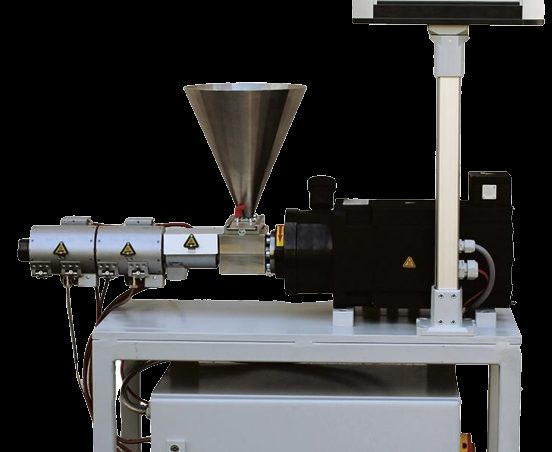
An extruder installation showing the feed hopper, barrel and drive end
From diagram to real machine. Find the hopper, the long barrel and the drive end in the photo.

Recognize the parts on a real machine.

Hopper on top
This is where the raw material enters. From here it reaches the screw inside the barrel.
Long body
The screw stays inside; from the outside you see the barrel and the heater zones around it.
Drive end
This is where rotation is passed to the screw. To understand the internal connection, look at the drive diagrams.

Photo: EMF Motor application archive. Product drawings and cross-sections: illustrations prepared for this guide.

What turns the screw, and how?

First we look at the mechanical connection. Then we separate out the motor technology: “synchronous motor”, “servo” and “direct drive” do not describe the same thing.

Mechanical drive layouts
DriveSpeed controlMotorBelt and pulleyGearboxThrust bearing*Screw* The bearing may sit in a separate housing or inside the motor / gearbox. The layout is illustrative.

A fast motor, a slower and stronger screw.

The motor’s motion reaches the screw first through a belt and pulleys, then through a gearbox. Together, the pulley and gear ratios set the screw speed.

What does it offer?
Offers layout flexibility and a choice of speed ratios. You may find it on existing machines.
What do we check?
Belt tension, alignment, guarding, bearing loads and gearbox oil are checked. Not every belt system has the same slip and loss behavior.
DriveSpeed controlMotorCouplingGearboxThrust bearing*Screw* The bearing may sit in a separate housing or inside the motor / gearbox. The layout is illustrative.

Speed reduction with gears, no belt.

The motor connects to a gearbox through a coupling. The gears lower the speed and raise the torque. A motor mounted close to the machine does not mean there is no gearbox.

What does it offer?
A wide operating range thanks to many motor and ratio options. It can include a thrust bearing suited to extrusion.
What do we check?
There are gear and bearing losses, lubrication, cooling and alignment. Continuous load and transient overload capacity are assessed together.
DriveSpeed controlHigh-torque motorThrust bearing*Screw* The bearing may sit in a separate housing or inside the motor / gearbox. The layout is illustrative.

The required torque is produced at screw speed.

A high-torque motor is connected to the screw without reduction gearing. In the single-screw example, motor speed equals screw speed. The connection can be made with a hollow shaft, spline, key or a suitable coupling.

What does it offer?
It can remove gearbox maintenance, and belt maintenance where there is a belt, creating a shorter mechanical chain. Stable low speed needs a suitable motor–drive match.
What do we check?
The torque–speed envelope, thrust bearing, shaft interface, cooling, mounting and drive compatibility are checked. Direct drive is not always free of water cooling; that depends on the motor design.
DriveSpeed controlMotorCouplingDistribution gearboxThrust bearing*Two screws* The bearing may sit in a separate housing or inside the motor / gearbox. The layout is illustrative.

The phase of the two shafts matters as much as their speed.

In the common layout, one motor’s power is split between two output shafts in a special gearbox. Its job is not only to reduce speed but also to keep the direction of rotation and the screws’ position relative to each other.

What does it offer?
With intermeshing screws, synchronization is kept mechanically. High torque can be transmitted to compact output shafts.
What do we check?
Driving two screws with two independent motors is not a simple matter of removing a gearbox. Phase synchronization, shaft/bearing loads and fault cases must be resolved with the machine builder.

Let’s also take a close look at the drive parts.

Behind the visible motor there are electrical, mechanical transmission and load-carrying tasks. Examine each part with the same questions.

Motor and driveFrom electricity to controlled rotation.
What is it?
The motor produces rotation of the shaft through electromagnetic interaction. The drive manages the current and frequency supplied to the motor with a suitable control method.
Where does it come from, what is it made of?
A motor consists of a housing, a stationary stator, a rotating rotor and bearings. It contains windings and magnetic steel parts; permanent magnets are only found in the relevant motor types. The drive contains power electronics.
What does it do inside?
It tries to hold the required screw speed while the load changes. Adequate continuous torque and thermal capacity matter as much as the peak kW.
What does the end user notice?
Stable speed supports steady production. Efficiency, cooling and maintenance needs affect operating costs; a good motor alone does not guarantee a good product.
What must be considered with it?
Screw speed and material throughput are not the same thing. Energy comparisons are made for the same amount of good product and the same system boundary.
Belt, coupling and gearboxThe path the motion takes from the motor to the screw.
What is it?
A belt is a flexible transmission element. A coupling connects two shafts. The gears in a gearbox change the ratio between speed and torque.
Where does it come from, what is it made of?
Belts are made, depending on type, from reinforced polymers; pulleys, shafts and gears from suitable metals. A coupling can be all-metal or have elastic elements; a gearbox has bearings and a lubrication system.
What does it do inside?
A gearbox provides higher torque at a lower output speed; it does not create energy. With direct drive, the required torque is produced by the motor at screw speed.
What does the end user notice?
Transmission losses, noise and maintenance downtime affect production costs. Correct alignment and a healthy transmission support continuous production.
What must be considered with it?
A visible coupling does not mean there is a gearbox; a motor close to the screw does not prove there is no gearbox either.
Radial and thrust bearingsCarrying the forces is as necessary as turning.
What is it?
A radial bearing carries loads acting on the shaft from the side; a suitable thrust bearing carries the thrust along the shaft. Depending on the design, one bearing can carry more than one load component.
Where does it come from, what is it made of?
Common rolling bearings have precision-machined rings, rolling elements and a cage. Lubrication and cooling are part of the bearing arrangement.
What does it do inside?
The back-thrust that melt pressure exerts on the screw is transferred to the frame through a suitable mechanical path. Removing the gearbox does not remove this force.
What does the end user notice?
Suitable bearings support continuous machine operation. Wear or alignment problems can increase downtime and the need for part replacement.
What must be considered with it?
It is not assumed that the motor’s own bearings carry the full extruder thrust. The load path and capacity are verified in the machine design.

Motor technology is a separate choice.

TechnologyHow to think about itWhat to watch for
Induction AC + driveCommon in variable-speed industrial drives. Often used together with a gearbox.Cooling at low speed, continuous torque, feedback and drive capacity.
Synchronous / permanent magnetWith the right design it can offer high torque density and efficiency; it can be used with or without a gearbox.The real torque–speed curve, drive compatibility, temperature and magnet limits.
Servo driveMotor, drive and feedback working together for precise motion control.The servo label does not mean “necessarily gearless”. The torque and thermal needs of the continuous process come first.
DC motorFound on older extrusion lines; used for wide speed control.Brush / commutator maintenance, spare parts, and keeping the operating points when modernizing.
Hydraulic / electro-hydraulicCommon in metal presses to produce high linear force; some special screw drives may also use a hydraulic motor.Pump, valves, oil temperature and total system losses. Press force and screw torque are not to be confused.
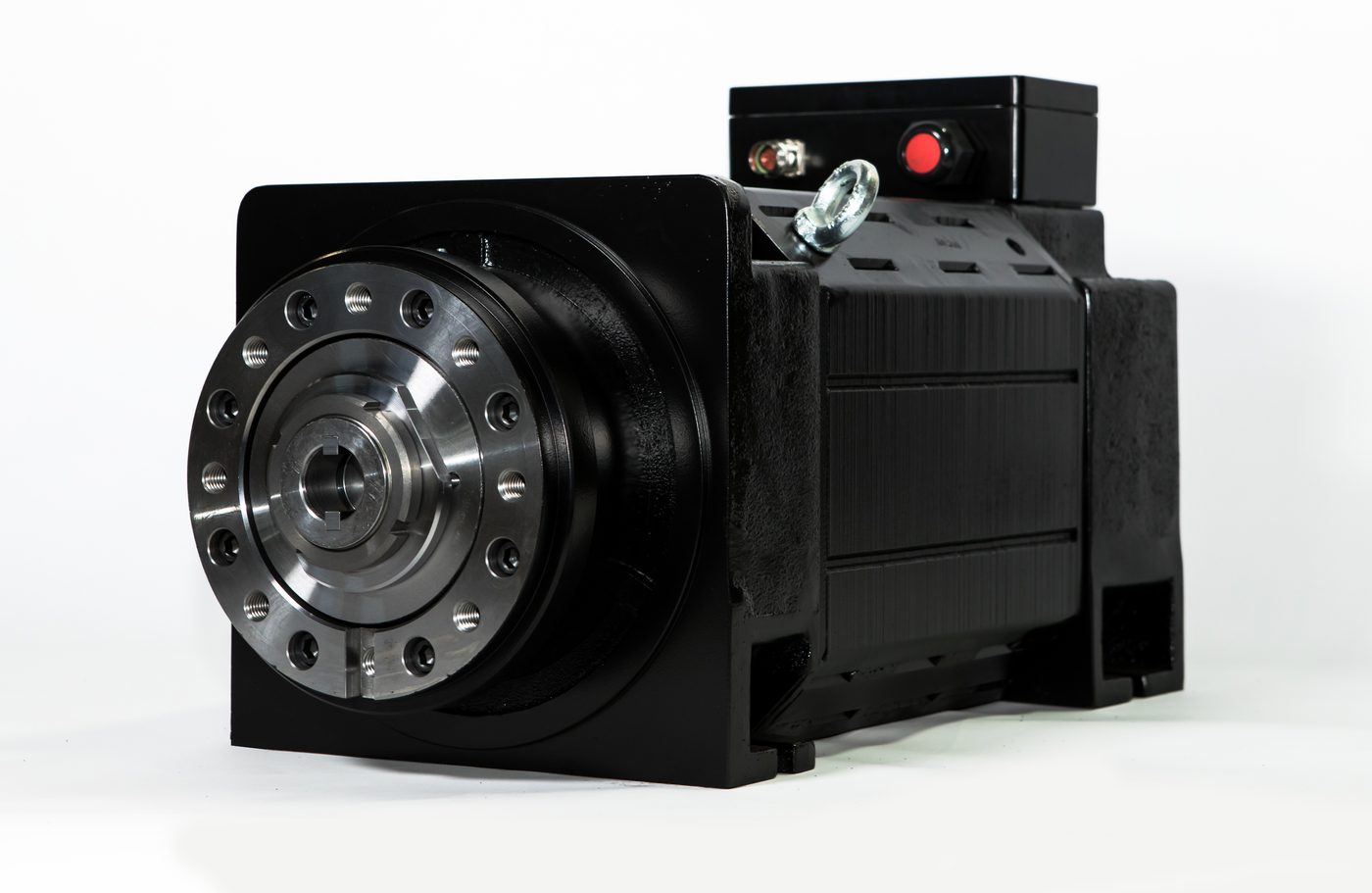
EMF SQME extruder motor showing the hollow-shaft connection
A real motor example: EMF SQME. The shaft interface, bearing and mechanical layout matter as much as the kW rating when choosing a motor.

What information does a gearless conversion need?

  • Minimum, continuous and maximum screw speed.
  • Torque at each operating point; starting and transient overload needs.
  • Existing motor power, speed and total reduction ratio.
  • Axial load, bearing life, shaft dimensions and connection standard.
  • For twin screws: power split and synchronization layout.
  • Material, recipe, kg/h, temperature and operating hours.
  • Drive, supply voltage, cooling and installation conditions.

A savings rate cannot be read from the motor nameplate alone. Before / after measurements are compared at the same product, the same good-product throughput and the same system boundary.

Explore EMF extruder motors →

Torque, power and thrust: three different quantities.

To understand motor selection, let’s first separate which job is described by which quantity.

Torque · Nm
The turning effect needed to rotate the screw. Similar to the effect your hand creates when opening a tight lid.
Speed · rpm
The number of turns the screw makes per minute. It does not have to equal the motor speed.
Power · kW
How fast work is done. On a rotating shaft it depends on both torque and speed: P = T × n / 9550.
Axial force · N or kN
The load pushing the screw backwards along its length. It is related to melt pressure and is carried by a suitable thrust bearing.
Backward thrust force (N)Torque (Nm)Thrust bearing → machine frame
A motor that can deliver high torque does not automatically have enough axial load capacity. The bearing is sized separately.

What happens if speed rises at the same torque?

In this teaching example the screw torque is fixed at 1,000 Nm. Move the slider and see the mechanical power needed at the shaft.

This is not a motor selection tool. The real motor’s continuous torque, speed range and cooling limits are checked separately.

Mechanical power at the screw shaft6.28 kW

1,000 × 60 ÷ 9,550

How does a gearbox multiply torque? A worked example

Assume 30 kW at 1,500 rpm at the motor shaft. Motor torque is then 9,550 × 30 ÷ 1,500 ≈ 191 Nm. With a 15:1 reduction ratio, the screw turns at 100 rpm.

If, for this example only, we take gearbox efficiency as 95 %: screw torque is 191 × 15 × 0.95 ≈ 2,722 Nm and screw power is 30 × 0.95 = 28.5 kW. A gearbox does not create energy; torque rises as speed falls, and some energy is lost.

If a gearless motor is to meet the same operating point, it must deliver about 2,722 Nm at 100 rpm. Saying “both are 30 kW” does not by itself show equivalence. The 95 % here is not measured product data; it is an assumption chosen to teach the calculation.

This equation refers to mechanical shaft power. The power drawn from the grid differs because of drive and motor losses. In a twin-screw system, total output power is the sum of each shaft’s T × n contribution; check whether the catalogue states torque per shaft or in total.

Don’t think of an extruder load like a fan load.

The “power rises with the cube of speed” approach used for fans does not apply directly to an extruder screw. Screw torque varies with resin, temperature, fill level, pressure, geometry and formulation. Lower speed does not always mean lower kWh/kg.

What does the operator actually control?

Turning one knob affects more than one result. The goal is not just to produce more, but to produce steadily at the same quality.

ParameterIn simple termsWhat does it affect?
Screw speedHow fast the screw turnsThroughput, fill level, mechanical energy and melt temperature. Throughput is not directly proportional to speed in every process.
Feed rateAmount of material fed per hourFill level and specific energy, especially in controlled / starve-fed twin-screw extruders. Feeder setting and screw speed are assessed together.
Barrel temperatureTarget for each zone’s metal temperatureHeat exchange and plasticizing. The displayed zone temperature is not the same as the actual melt temperature.
Head pressureIndicator of flow resistance in front of the dieScreen contamination, die resistance and flow conditions. A sudden rise alone does not prove the cause of a fault.
Motor torque / loadHow hard is it to turn the screw?Material viscosity, fill level and mechanical limits. Whether the load reading means % or Nm depends on the drive.
Vacuum / degassingRemoving volatiles from the meltManaging moisture, trapped air and gases. Not every machine has it; it does not automatically replace drying.
Haul-off / winding speedHow fast the product moves at the end of the lineMaterial per unit length and product dimensions. It must match cooling and melt throughput.
kWh/kgElectricity per kilogram of good productComparisons must use the same formulation, good-product throughput and measurement boundary. Do not mix a motor-only measurement with a whole-line measurement.
Reading a datasheet: diameter, L/D, capacity and specific torque

Screw diameter (D): The outer diameter measured over the flight tips. A “90 extruder” usually means a 90 mm screw diameter, not the diameter of the product.

L/D: The ratio of effective screw length to diameter. With D = 60 mm and L/D = 30, that length is 1,800 mm. For twin-screw and conical machines, check the maker’s definition of length/diameter. A longer screw is not better for every formulation.

Channel depth and compression ratio: On a classic single screw, this relates to the geometry of the feed channel and the metering channel. It is not the pressure ratio at the die. Barrier and special screws can be more complex than three simple zones.

Capacity (kg/h): Depends on the material and the test conditions. Two machines of the same diameter do not give the same throughput with different resins and screw designs. The dryer, screen, die, cooling and haul-off can also limit capacity.

Specific torque: Torque normalized to a particular geometric quantity, especially in twin-screw catalogues. It is not the same number as total Nm; before comparing makers, read the definition and any “per shaft” note.

SME: Specific mechanical energy delivered per unit of material. It depends on how it is measured and corrected for losses; it is not the same indicator as the electricity consumption of the whole line.

When you see a problem in the product…

A symptom alone does not reveal the root cause. The links below are a starting point for understanding the process.

Bubbles or voids

Moisture, trapped air, insufficient degassing or material degradation are possible causes. The resin’s drying requirement, vacuum status and melt temperature are examined together.

Thickness / throughput fluctuation

Look into fluctuations in feeding, speed control, temperature, pressure and haul-off. Do not conclude “the motor is fluctuating” from the product alone.

Burnt spots or discoloration

Long residence time, excess heat, dead zones or contamination may be involved. Follow the formulation and the maker’s cleaning procedure.

Rising pressure and torque

Possible causes to examine: a clogged screen, low melt temperature, a formulation change or a mechanical problem. Pressure safety devices and guards are never bypassed.

Low capacity

Possible causes: insufficient feeding, wear, die/screen resistance or a downstream limit. Increasing motor power alone may not solve it.

A running machine has hot surfaces, pressurized melt and rotating parts. This page teaches process logic; for any intervention, start-up or shutdown, follow the machine maker’s instructions and the plant’s energy isolation procedure.

How does a decision in the factory feel in everyday life?

The chains below are teaching examples. A single symptom is not tied to a single cause; material, process and product measurements are assessed together.

The bag should open easily.

  1. INPUT / PARTSuitable slip and antiblock agents
  2. WHAT HAPPENS IN THE PROCESSCorrect dosing, distribution and winding
  3. WHAT IT MEANS IN THE PRODUCTLayers separate more easily

Two films made from the same PE can open differently because of the additive package, thickness, surface and storage conditions. Adding more additive is not the only solution.

The window profile should fit during installation.

  1. INPUT / PARTSuitable PVC formulation and die
  2. WHAT HAPPENS IN THE PROCESSBalance of calibration, cooling and haul-off
  3. WHAT IT MEANS IN THE PRODUCTDimensions and straightness are held

If the dimensions are wrong, good raw material alone is not enough. Resistance to impact and weathering is assessed separately through the formulation and product tests.

The cable should bend; its sheath should be consistent.

  1. INPUT / PARTSuitable insulation / sheathing compound
  2. WHAT HAPPENS IN THE PROCESSWire speed, output and cooling are matched
  3. WHAT IT MEANS IN THE PRODUCTFlexibility and coating thickness are targeted

The copper conductor, insulation and outer sheath each have their own job. Electrical and fire performance are assessed through the design and testing of the finished cable.

Test what you’ve learned with eight questions.

Tap an answer. Next to the correct option you’ll also see why.

1. What is the usual starting choice for making water pipe from ready-to-use PE pellets?

2. Which family is common for mixing glass fiber and additives into a polymer?

3. Which component takes the pressure load pushing the screw backwards?

4. At the same torque, what happens to mechanical power if screw speed doubles?

5. Does a three-layer film always need a single machine with three screws?

6. Does using 2 % masterbatch always mean using 2 % pure pigment?

7. With the same raw material and constant kg/h, how does mass per meter change if the haul-off speeds up?

8. What can be concluded about PE made from sugar cane?

A small extruder glossary.

Pellet
A small grain of plastic raw material.
Melt
Thermoplastic material that heat has made able to flow. It does not have to be as runny as water.
Plasticizing
Making the material formable and able to flow.
Compound
A material made by mixing additives, fillers or other components into a polymer.
Masterbatch
An intermediate product rich in color or additives, dosed into later production.
Die
The tool the flow passes through and takes its cross-section from.
Calibration
Bringing the soft product to its dimensions in a controlled way.
Degassing / venting
Removing air, moisture or other volatiles through a suitable section.
Viscosity
A material’s resistance to flow; think of it as its consistency.
Vulcanization / curing
Making the structure of rubber or a suitable material permanent through chemical bonds. It is not just cooling.
Starve feeding
Keeping the feed controlled and below what the screw could take in. The screw is not completely full in every zone.
Flood feeding
A layout where material is always present at the feed inlet and the screw’s intake sets the throughput.

About this guide.

This guide explains the basic mechanisms and common applications of extrusion in simplified form. When choosing material and machine, product class, process conditions and intended use are assessed together.

Last content expansion: 20 October 2026. Diagrams are not to scale. The torque and mixing examples are teaching calculations; they are not a production recipe or an operating approval for a machine. The everyday-use examples are not measurements or a service-life guarantee for any product.

Let’s look at your line together.

If you are thinking of converting a geared extruder to direct drive, share your screw speed, torque and current motor data. Our engineers will assess with you which EMF SQME motor suits your line.