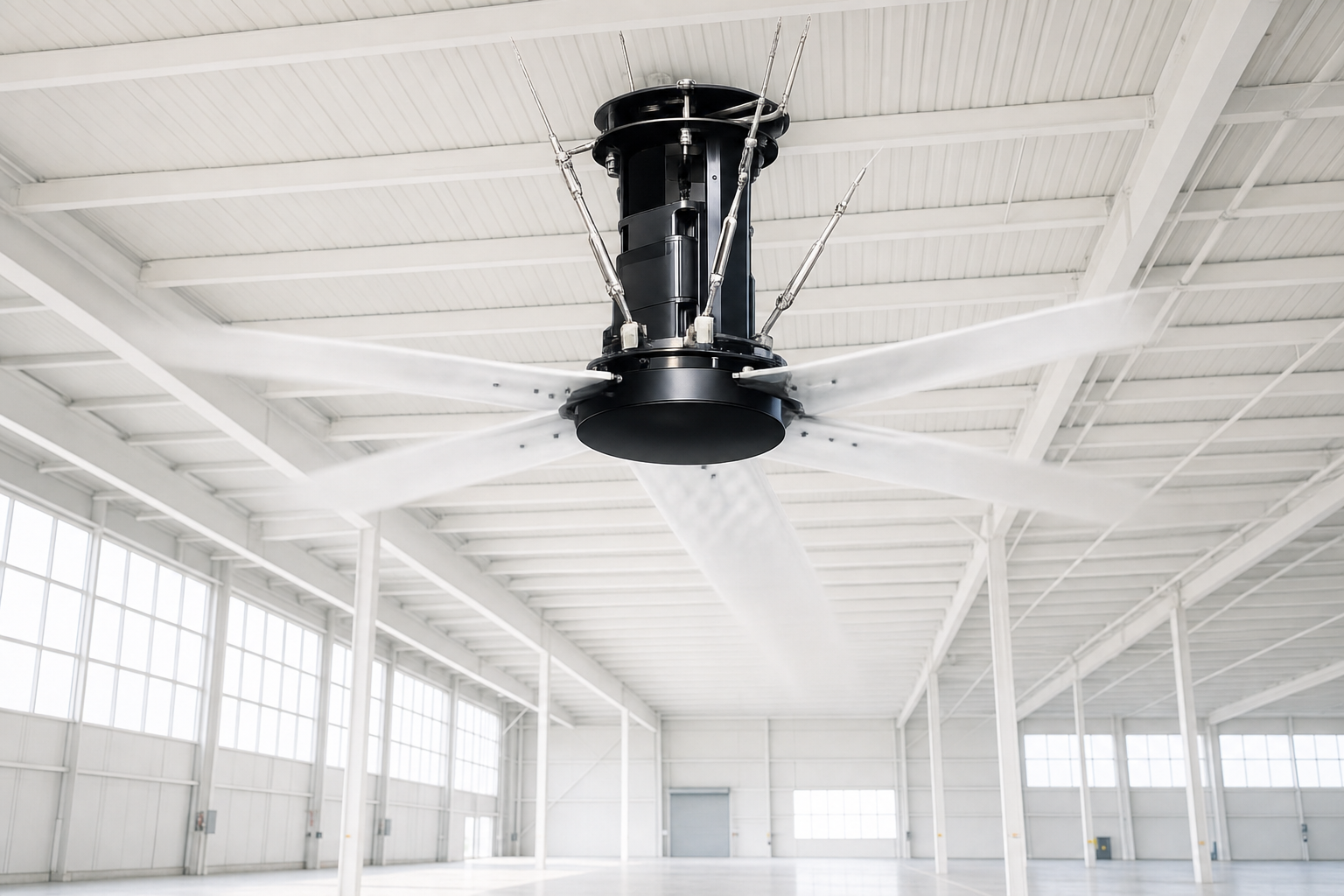
A modern HVLS (High Volume Low Speed) fan is judged on three numbers: how much air it moves, how much power it draws, and how often someone climbs a lift to service it. The single design choice that decides all three is whether the fan has a gearbox — or a direct drive HVLS fan motor turning the blades. That distinction is the whole article.
Direct drive HVLS fans use a permanent magnet motor bolted straight to the fan hub. No reduction gearbox. No belt. Fewer moving parts, less heat, less noise, and a service interval measured in years — not months.
For a facility manager in a US distribution center, a plant engineer in Stuttgart, a spec buyer in Chennai, or a portside operations lead in Singapore, the trade-off looks the same. The building is big, the ceiling is high, the fans run for years, and every kilowatt-hour and every service call shows up on the P&L. This piece walks through what direct drive actually changes at the motor level, and where an EMF Motor HVLS platform fits.
The problem direct drive fixes
Conventional HVLS fans borrow their drivetrain from ordinary induction machines: a high-speed motor spinning at 900–1,500 RPM, reduced through a right-angle gearbox to the 10–60 RPM the blades actually need. It works. It also brings every problem you would expect from a gear reducer running continuously in a hot ceiling space.
The gearbox is the failure point. Gear oil oxidises. Seals weep. Under continuous duty in a 40–50°C ceiling zone, viscosity drifts and wear accelerates. Every one of those service calls needs a lift, a technician, and downtime on the fan.
Direct drive removes the entire chain. Nothing to lubricate. Nothing to align. Nothing to replace between the motor rotor and the fan hub.
Gearbox-driven HVLS fan
- Motor + right-angle reducer + coupling
- Gear oil changes on a schedule
- Transmission losses through the gear train
- Audible gearbox whine in the ceiling zone
- Failure-prone under continuous duty and high ambient
EMF direct drive HVLS motor
- Permanent magnet motor bolted to the fan hub
- No oil, no gear wear, no coupling
- Up to 92% motor efficiency at low RPM
- Below 40 dB — retail-space quiet
- Designed for continuous operation at 50°C ambient
What “direct drive” actually means at the motor
An EMF HVLS motor is a permanent magnet synchronous machine with a high pole count. That construction is what lets the motor produce continuous torque at 10–60 RPM without needing a gearbox to trade speed for torque. The magnets do the trading.
Because the rotor is turning at fan speed — not gearbox-input speed — the frequency the drive has to switch at is low, the iron losses stay low, and the motor stays cool. Combined with sensorless control (no encoder in a dusty, high-vibration ceiling environment), the result is a drive-and-motor package that is genuinely install-and-forget.
Nothing here is exotic. Direct drive PM motors are the same architecture EMF uses in torque motors for winder tension control and in gearless cooling tower fans. In an HVLS fan the priorities shift — very low speed, large-diameter aerodynamic load, decades of continuous duty — but the underlying reason to go gearless is the same. Fewer components in the load path means fewer things that can drift, wear, or fail.
Speed control that follows the building
An HVLS fan is not a two-speed appliance. Occupancy shifts through the day, dock doors open, forklifts warm the aisles, and afternoon sun stacks heat at the roofline. The direct drive motor pairs with an integrated servo controller that adjusts fan speed continuously across the 10–80 RPM window, driven by temperature, occupancy, or a building management signal.
Because the drive is running a low-inertia direct-coupled load — no gearbox, no long shaft — speed changes are smooth and near-silent. Over-voltage, over-current, and thermal protections are built into the controller, so a brownout or a stalled fan does not cascade into a burnt winding. In practice, this is what install-and-forget looks like on a real facilities schedule: one BMS tag per zone, one setpoint, no manual intervention.
The numbers that matter
A single 7.3-meter direct drive HVLS fan can cover 800–1,500 m² of floor while drawing 0.8–1.5 kW. That is one motor, at the power of an office espresso machine, doing the work of 10–20 traditional high-speed pedestal or column fans.
The middle number is the one worth pausing on. A right-angle worm or bevel gearbox running continuously in a hot ceiling zone gives up 15–25% of shaft power to friction and heat, depending on stage count and lubricant condition. Direct drive removes that loss category entirely — it is a mechanism, not a marketing figure.
Two second-order effects usually matter more than the direct fan bill. In summer, low-velocity air movement across the skin shifts the perceived temperature — the elevated air speed cooling effect that ASHRAE Standard 55 formalises. Per the EMF HVLS Motor product page, occupants can feel up to 8°C cooler at the same air temperature, which lets facility managers raise the thermostat set point without complaints. In winter, the same fan reversed at low RPM destratifies the warm air trapped at the ceiling and pushes it back down — per the same EMF product spec, cutting heating loads by up to 30% in tall spaces.
Neither of those savings shows up in a fan spec sheet. They show up on the HVAC bill.
An EMF HVLS motor at a glance
| Parameter | EMF HVLS Motor |
|---|---|
| Architecture | Permanent magnet synchronous, direct drive |
| Compatible fan diameter | 3 – 7.3 m |
| Operating speed | 10 – 80 RPM |
| Motor efficiency | Up to 92% |
| Ambient rating | Up to 50°C |
| Supply voltage | 220 – 400 V (single motor platform) |
| Control | Sensorless PM — no encoder |
| Noise | Below 40 dB |
| Gearbox / belt | None |
| Service life | 20+ years continuous |
Every value above is from the product page or the HVLS Motor Catalogue on /en/products/hvls-motor.
The 220–400 V range is not a small point. A single motor SKU that runs on the local supply in Detroit, Duisburg, Coimbatore, or Tuas removes a stocking headache for the fan OEM and a spec headache for the end-user electrical designer. One motor family, one spare part, one wiring diagram.
Where direct drive HVLS fans earn their place
The buyer profile is remarkably consistent across markets, even when the building is not.
US distribution centers and 3PL warehouses. Ceiling heights of 12–15 m, thousands of square meters per zone, HVAC that struggles to serve the occupied bottom third of the room. A grid of direct drive HVLS fans destratifies the stack and lets the HVAC work in a narrower band. The gearless motor matters here because a fleet of 12–40 fans running two shifts a day is a lot of gear oil changes over 20 years.
German manufacturing halls. The buyer priority is measured efficiency and clean documentation. A motor with a stated efficiency figure, a stated ambient rating, and no consumables is easier to defend to a Werksleitung and easier to feed into an ISO 50001 energy management report.
Indian factories and logistics parks. Continuous 40–45°C ceiling temperatures during summer, and grid supply that is not always kind. A motor rated to 50°C ambient with a 220–400 V wide-voltage platform is genuinely usable, not just quotable. The low noise floor keeps the fan viable in mixed-use blocks with adjoining offices.
Singapore ports, warehousing and MRT depots. Continuous operation, high humidity, tight noise ordinances near residential zones. Gearless architecture removes the acoustic signature that gives conventional HVLS fans away.
Different markets, same reason to choose direct drive: the motor is the part of the fan that never sleeps, and everything you save on gearboxes accrues for the life of the building.
What engineers usually ask
Does a direct drive HVLS motor really need no maintenance?
Effectively yes. No gearbox means no oil to change and no gears to wear. Recommended service is periodic visual inspection and exterior cleaning; sealed bearings and brushless PM construction remove the usual failure points. Typical service life exceeds 20 years of continuous operation.
How do I size the motor to the fan diameter?
EMF HVLS motors cover fan diameters from 3 to 7.3 m across a 10–80 RPM operating window. Sizing is driven by the fan blade geometry, the target CFM at design speed, and the ambient duty profile — share those and we spec the matching motor.
Can it run in a 45–50°C ceiling zone all day?
Yes. The motor is rated for continuous operation up to 50°C ambient, which is the design case for Indian summers, Middle Eastern warehouses, and unconditioned metal-clad halls anywhere.
Do I need an encoder or feedback device?
No. The motor is optimised for sensorless PM control — the drive tracks rotor position from motor terminal signals. That removes a fragile device from a vibration-heavy install location.
Can one motor SKU cover 220 V and 400 V sites?
Yes. The wide-voltage platform (220–400 V) means the same motor ships to US, EU, Indian and Southeast Asian markets without a voltage-specific variant.
Answered by EMF Motor application engineering.
The related conversation: cooling towers
If HVLS fans are the case study for direct drive at low speed, gearless cooling tower motors are the case study for direct drive at low speed in worse weather. The engineering argument is the same — remove the gearbox from a fan that runs 24/7 in a hot, wet location and the maintenance line disappears. It is worth a look for any facility team already considering an HVLS retrofit; the payback logic is the same building, one deck up.
Key takeaway
Direct drive HVLS fans replace the gearbox, the belt, and the service ladder with a permanent magnet motor. That is where the energy savings, the low noise floor, and the 20+ year service life all come from.
Sizing a direct drive HVLS fan for your building?
Tell us the fan diameter, ceiling height, ambient temperature and duty cycle. We will size the motor and send the catalogue.
Request a quote