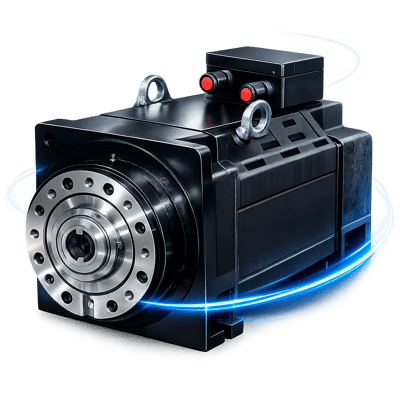
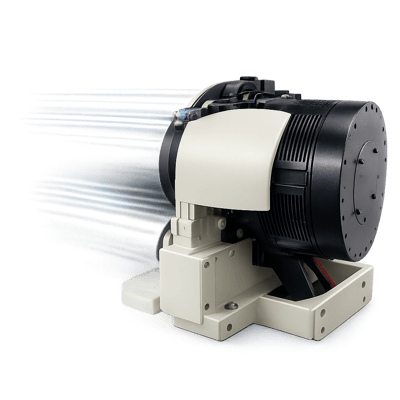
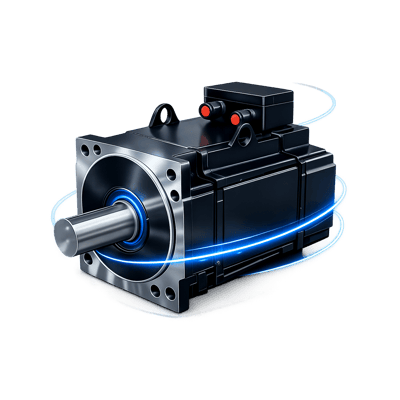
SQM Torque Motor
Key Features
Direct Drive Technology
Eliminates gearboxes and mechanical transmission components
Exceptional Precision for Servo Applications
The gearless direct drive eliminates play (backlash) and enables high-precision torque and position control.
Driveability even with V/f Driver
Operates reliably with conventional V/f drives, reducing drive complexity and system cost.
Maximum Torque even at Low Speeds
Direct drive enables high torque density at low speeds without transmission losses.
No Maintenance
No gearbox. No lubrication. No scheduled service required.
Compact Design
Space-saving installation in existing production lines
Quiet Operation
Direct drive eliminates gearboxes and mechanical noise sources, ensuring quiet and low-vibration operation.
High Overload Capacity
Delivers high peak torque to handle sudden load changes and demanding operating conditions.
Technical Specifications
Downloads for SQM Torque Motor
Frequently Asked Questions
A torque motor is a direct drive electric motor designed to produce high torque at low rotational speeds. Unlike conventional motors, it operates without a gearbox or mechanical transmission. This allows the load to be driven directly by the motor shaft.
A direct drive torque motor is a permanent magnet synchronous motor designed to deliver high torque at low rotational speeds without requiring a gearbox, belt, or coupling. The motor drives the load shaft directly, eliminating mechanical transmission losses. EMF torque motors use high pole counts (66 to 110 poles) to produce smooth, stable torque across a wide speed range, making them ideal for tension-controlled winding and unwinding processes.
A torque motor generates torque directly through electromagnetic interaction between the stator and rotor. Permanent magnets and a high pole count enable the motor to produce high torque even at very low speeds. Speed and torque are typically controlled using a variable frequency or servo drive.
Direct drive torque motors eliminate the gearbox, belts, and couplings from the drivetrain. This removes mechanical backlash, reduces maintenance requirements, and improves energy efficiency by up to 96%. A 19 kW conventional servo motor with gearbox can often be replaced by a 4 kW EMF torque motor delivering the same output torque, significantly reducing energy consumption. Additional benefits include lower noise, zero lubrication requirements, and longer machine service life.
Torque motors are used in direct drive systems because they eliminate gearboxes, belts and couplings. Removing these components reduces mechanical losses, simplifies the drivetrain and improves overall system reliability. Direct drive architectures also enable more precise control of speed and torque.
EMF torque motors are widely used in winding and unwinding systems across multiple industries. Key applications include plastic film extrusion winders, paper and foil converting lines, textile winding machines, cable and wire spooling systems, rubber calendering lines, battery foil winding, metal coil recoilers, and printing press rewinders. Any process requiring precise tension control at variable speeds benefits from direct drive torque motor technology.
A conventional motor usually operates at high speed and requires a gearbox to increase torque. A torque motor produces high torque directly at low speeds, allowing the load to be driven without mechanical transmission components. This reduces complexity, maintenance and energy losses.
During winding, the roll diameter increases continuously, which changes the required torque to maintain constant material tension. EMF torque motors provide precise torque control across the full speed range, allowing the drive system to adjust torque in real time as the diameter changes. This ensures uniform tension from core to full roll, preventing wrinkles, film breaks, or uneven coil formation. Both direct tension control (with load cells) and indirect torque-based methods are supported.
Torque motors are widely used across many industrial applications requiring high torque at low speeds and precise motion control. Typical uses include extrusion systems, winders and unwinders, rotary tables, indexers, tension control systems, large industrial fans, and various servo-driven applications. They are applied in many sectors of industry where smooth torque delivery and stable low-speed operation are essential, and many other motion control systems.
EMF torque motors deliver continuous torque up to 57,000 Nm with power ratings from 1 to 500 kW. Operating speeds range from near-zero to 600 RPM depending on the model. Available pole configurations of 66, 88, and 110 poles allow the motor to be optimized for specific application requirements. The motors can operate without water cooling even at very low speeds, maintaining full rated torque across the entire speed range.
Torque motors are used in many industrial sectors including plastics processing, metal processing, packaging, paper converting and industrial automation. They are also common in HVAC systems, large fans and precision motion applications. Their high efficiency and reliability make them suitable for demanding industrial environments. They can be used in virtually any industry where applications require high torque at low speeds.
Yes. EMF torque motors are engineered for both new installations and retrofit applications. The compact, high-torque design allows direct replacement of conventional motor-plus-gearbox configurations, simplifying the mechanical layout. Retrofit installations typically result in reduced footprint, lower energy costs, elimination of gearbox maintenance, and improved product quality due to smoother torque delivery. EMF motors are compatible with industry-standard variable frequency drives and servo controllers.
Torque motors are typically more efficient than systems using a motor and gearbox combination. Eliminating the gearbox removes mechanical losses caused by friction and transmission components. This can significantly improve overall system efficiency, especially in low speed applications.
Torque motors are designed to operate efficiently at low rotational speeds. Depending on the design and application, they typically run from a few revolutions per minute up to several hundred RPM. Their ability to produce high torque at low speed makes them ideal for direct drive systems.
A torque motor is optimized for producing high continuous torque at low speeds, often in direct drive applications. Servo motors are typically smaller, higher-speed motors designed for precise positioning and dynamic motion control. In many systems, torque motors can function as large direct drive servo motors.
Yes, torque motors can replace gearboxes in many industrial machines. Because they generate high torque directly at low speeds, the load can be driven without mechanical reduction systems. This simplifies the drivetrain and reduces maintenance requirements.
A high pole count allows the motor to generate strong magnetic interaction at low rotational speeds. This increases the torque produced without requiring mechanical reduction. As a result, torque motors with many poles can deliver high torque smoothly and efficiently.
Conventional motors lose efficiency at low speeds because they rely on gearboxes for torque multiplication. Torque motors are designed to produce torque directly at low speeds without mechanical transmission. This eliminates gearbox losses and improves overall system efficiency.
Yes. Torque motors require a drive because they do not operate directly at grid voltage and frequency. This allows precise control of speed and torque. In applications where stable speed control is sufficient, a variable frequency drive is used, while servo drives are preferred in applications requiring precise position control.
Have a Question?
Our technical team will get back to you as soon as possible.