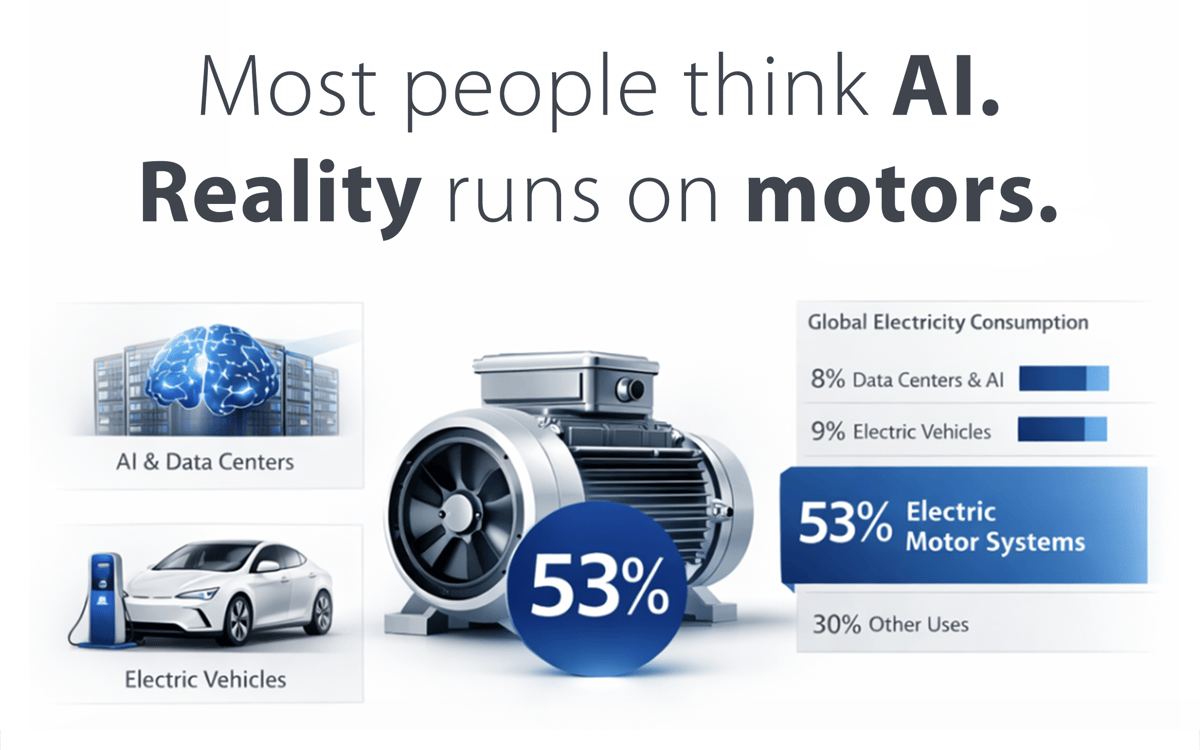
Global energy discussions often focus on generation.
However, the real opportunity lies in how energy is used.
And at the center of this lies motor-driven systems.
Electric motor systems account for approximately 50–55% of global electricity consumption.
In industrial environments, this share rises to 60–70%, and at plant level, motor-driven systems often exceed 70% of total electricity use.
This is not a secondary layer of the system.
It is the system.
Despite this scale, the underlying architecture of motor usage has remained largely unchanged.
Most industrial applications still rely on:
Multi-stage mechanical transmission systems
Load-dependent efficiency losses
Maintenance-intensive components
These structures were not designed for energy efficiency, but around mechanical constraints.
This creates a structural inefficiency:
We are attempting to optimize energy consumption on top of architectures that inherently dissipate energy.
In industrial environments, motor systems are not only energy consumers, but core drivers of production.
This makes them one of the most impactful leverage points for improving overall system efficiency.
The scale of impact is significant:
A 10–15% improvement in motor system efficiency can translate into approximately 5% reduction in global electricity demand.
Very few interventions offer this level of systemic leverage.
The implication is clear:
Energy transition is not only a generation problem.
It is a system design problem.
At its core, it is about how motion is generated, transmitted, and controlled.
Industrial systems are entering a phase where efficiency, simplicity, and reliability are no longer independent targets, but interconnected design priorities.
Improving motor-driven systems is not an incremental optimization.
It is one of the most direct and scalable ways to reduce global energy demand.
Sources
IEA – Electric Motor Systems:
https://www.iea-4e.org/emsa/publications/policy-brief-electric-motor-systems-why-are-they-important/
Research Nester – Electric Motor Market:
https://www.researchnester.com/reports/electric-motor-market/6228
IPIECA – Electric Motors (2023):
https://www.ipieca.org/resources/energy-efficiency-compendium/electric-motors-2023
IEA – Walking the Torque:
https://www.iea.org/reports/walking-the-torque