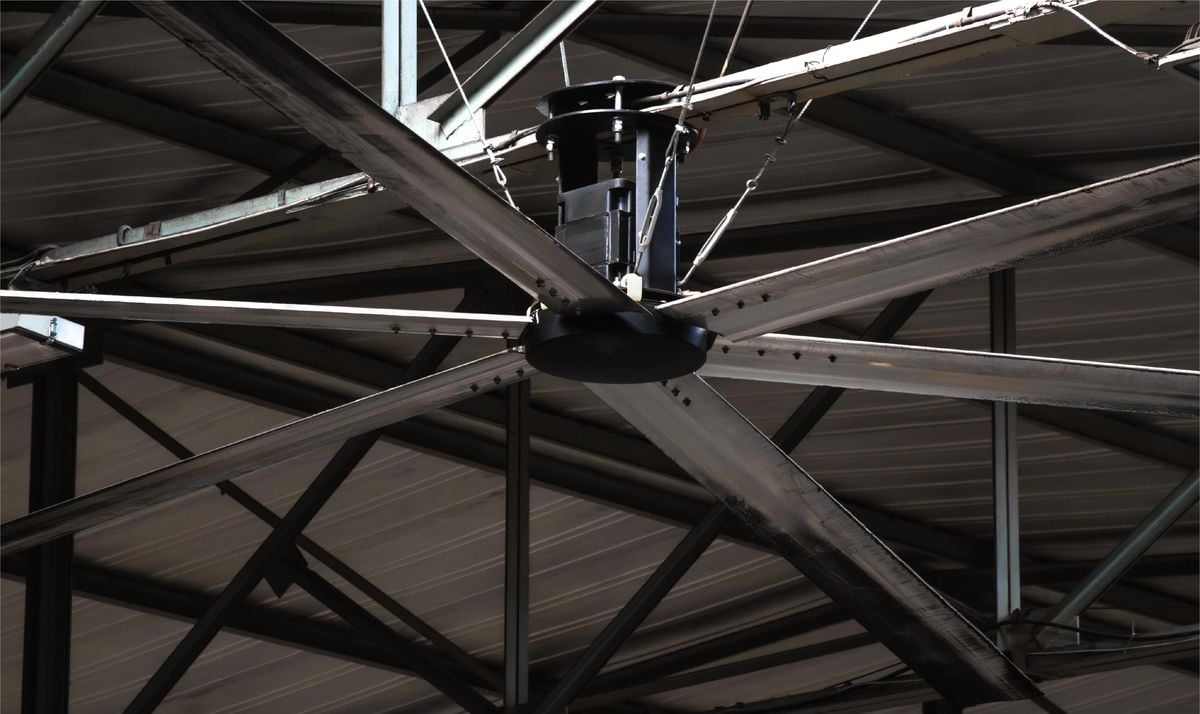
HVLS Fans Are Simple. The Motor Behind Them Is Not.
In large warehouses and distribution centers, airflow is often treated as a simple problem.
Install larger fans. Move more air. Solve the issue.
In reality, the challenge is not only moving air.
It is moving a very large volume of air at very low speed, with stable torque and continuous efficiency over long operating hours.
This is what defines an HVLS system.
What Is an HVLS Fan?
HVLS stands for High Volume, Low Speed.
These systems use large-diameter blades operating at low rotational speeds to generate a wide, slow-moving air column across the entire space.
The objective is not high-velocity airflow.
It is uniform air distribution from ceiling level to the occupied area.
Why Air Distribution Matters More Than Airflow
In high-bay buildings, airflow performance is rarely limited by fan quantity.
The real limitation is how effectively air is distributed vertically.
Poor air distribution leads to:
- heat stratification
- uneven temperature zones
- reduced comfort at floor level
A properly designed HVLS system improves:
- air mixing across the entire volume
- perceived cooling in summer conditions
- heat recirculation in winter
- overall airflow consistency in large open spaces
The Real Engineering Challenge: Low-Speed Torque
Driving a large-diameter HVLS fan is not a conventional motor application.
It requires:
- high torque at very low speed
- smooth acceleration and deceleration
- stable continuous operation
- high efficiency under long duty cycles
- compact design suitable for overhead installation
This is fundamentally a low-speed, high-torque problem.
Limitations of Gearbox-Based HVLS Systems
Many HVLS systems rely on gearbox-driven configurations.
This introduces:
- additional mechanical components
- transmission losses
- oil and lubrication requirements
- wear-related maintenance
- potential vibration and noise
Over time, these factors directly impact reliability and operating cost.
Direct Drive HVLS Motors: A Simpler Architecture
A direct drive system eliminates the gearbox.
The motor drives the fan directly, without intermediate mechanical transmission.
EMF Motor’s HVLS solution is based on
direct drive permanent magnet motor technology.
This approach provides:
- high torque at low RPM
- precise and stable speed control
- reduced mechanical losses
- lower maintenance requirements
- quiet and smooth operation
Why the Motor Defines Long-Term Performance
In HVLS systems, the fan is the visible component.
The motor is not.
However, long-term system performance depends on:
- operational stability over thousands of hours
- efficiency under continuous load
- maintenance requirements over time
In other words:
The fan moves the air.
The motor defines how well it is done.
Conclusion
HVLS systems are often evaluated based on size.
But size alone does not determine performance.
The real question is:
How efficiently can you convert low-speed rotation into stable, usable airflow — every day, for years?
Explore EMF Direct Drive HVLS Motors
EMF Motor develops direct drive motor solutions for HVLS applications, delivering high torque at low speeds without gearbox-related losses or maintenance requirements.
👉 https://www.emfmotor.com/en/products/hvls-motor
Frequently Asked Questions
What is an HVLS motor?
An HVLS motor is designed to drive large-diameter fans at low rotational speeds while delivering high torque and stable performance.
Why is direct drive important in HVLS systems?
Direct drive eliminates the gearbox, reducing mechanical losses, maintenance requirements, and improving overall system efficiency.
How does an HVLS fan improve warehouse cooling?
HVLS fans create uniform air distribution, reducing heat stratification and improving perceived temperature without increasing cooling load.
What are the advantages of permanent magnet motors in HVLS applications?
Permanent magnet motors provide high efficiency, precise control, and stable torque at low speeds, making them ideal for HVLS systems.