
Margarine and spread production is a sequence of controlled physical states. Liquid oil and water phases are prepared, emulsified, pasteurized, cooled, crystallized, mechanically worked and filled. Several of those steps are produced by low-speed, high-torque rotary motion — the point at which the drivetrain stops being a detail and begins to influence process stability, maintenance and control.
Process in one line
Why direct drive
- Low-speed torque
- The motor produces process torque at shaft speed without relying on a gearbox.
- Direct control
- Speed and torque follow the recipe and remain visible to the control system.
- Fewer interfaces
- Gearbox, coupling and associated alignment points can be removed where the shaft arrangement permits.
What conventional systems add
- Wear points
- Gears, bearings, seals and couplings introduce additional maintenance items.
- Backlash and alignment
- Mechanical transmission can affect response and increase sensitivity to installation accuracy.
- Hidden process load
- Changes in viscosity or scraper resistance are less visible when measured upstream of a gearbox.
The engineering case is strongest where a gearbox currently creates low-speed, high-torque rotary motion.
Application review
Where EMF direct drive fits the process
The primary candidates are agitators, scraped surface heat exchangers and pin worker units. Pumps and packaging drives require separate evaluation and should not be grouped automatically with these loads.
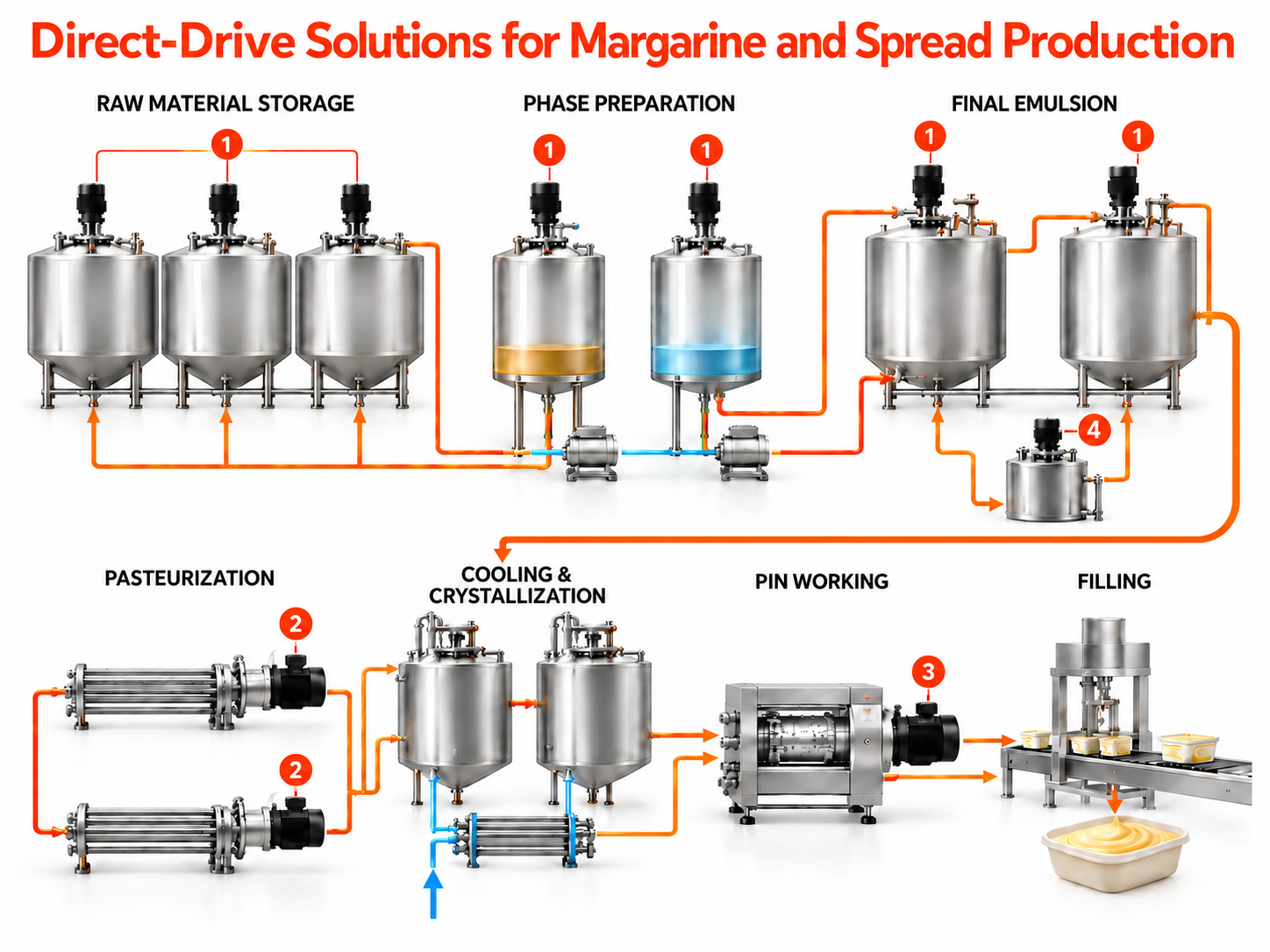
- 1Tank agitators — storage, phase preparation and final emulsion
- 2Pasteurizer scraper shafts
- 3Pin worker unit
- 4Rework / remelt vessel agitator
Tank agitators
Direct coupling suits selected oil, phase-preparation, emulsion and rework tanks. Check cold-start torque, impeller load and shaft bearings.
Drive point 1 & 4SSHE and LP pasteurizer
A coaxial torque motor can drive each scraper shaft directly. Size from measured shaft torque — not the existing motor kW alone.
Drive point 2Cooling and crystallization
Torque trends can expose viscosity changes, build-up and scraper resistance when reviewed with temperature and flow.
Pin worker unit
Low-speed torque and precise speed control support consistent mechanical working of the developing crystal structure.
Drive point 3The drivetrain
What changes with EMF
Simpler drivetrain
Direct shaft connection can remove the gearbox and coupling from suitable applications.
Process visibility
Motor speed and torque become usable operating data for recipes, alarms and condition monitoring.
Low-speed operation
High pole-count permanent-magnet design is matched to continuous torque at process speed.
Specification
Selection starts with shaft data
Required inputs:
- Speed range
- Continuous and peak torque
- Product temperature and viscosity
- Duty cycle
- Shaft loads
- Mounting arrangement
- Washdown conditions
- Feedback requirements
Direct drive is not a universal replacement. It is a drivetrain decision for applications where the process already demands controlled torque at low speed.
Review a drive point with our engineers
Send the shaft data for one agitator, scraper shaft or pin worker and we will return a direct-drive sizing proposal.
Contact EMF Motor Agitator torque toolEMF Motor — Direct. Efficient. Reliable.