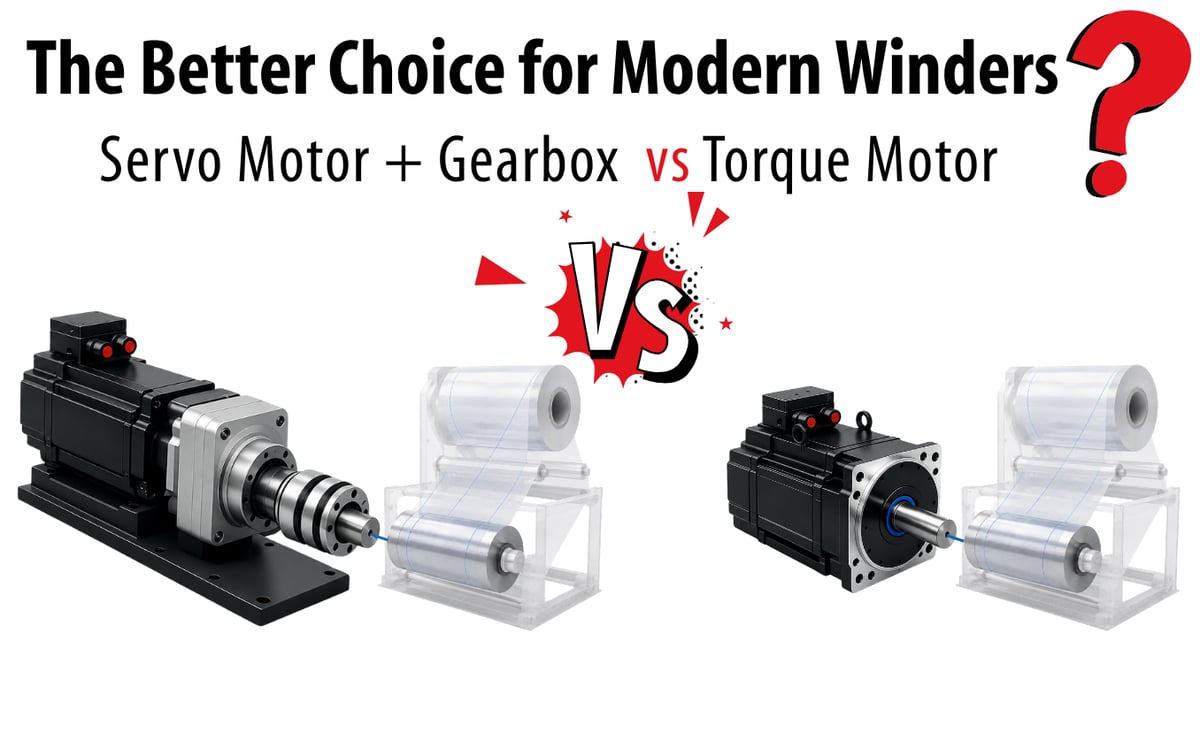
If you are designing or upgrading a winder, the motor is only part of the decision. The real question is how torque reaches the winding shaft.
Most winding machines still use a conventional drivetrain:
Motor → Gearbox → Coupling → Winding Shaft
Others use a direct-drive torque motor:
Torque Motor → Winding Shaft
Both approaches can wind material. Both can maintain tension. Both can produce acceptable rolls. However, they differ significantly in efficiency, maintenance requirements, controllability, system complexity, and long-term operating cost. This article compares torque motors and servo motors with gearboxes specifically for winding and unwinding applications.
The challenge of winding
A winding application is fundamentally different from a standard motion-control task. As roll diameter increases:
- Shaft speed decreases
- Torque demand increases
- Roll inertia increases
- Tension must remain constant
A drive system must therefore deliver stable torque, precise speed control, fast dynamic response, and reliable low-speed operation throughout the entire winding cycle. This is where the differences between drivetrain architectures become important.
Traditional solution: servo motor + gearbox
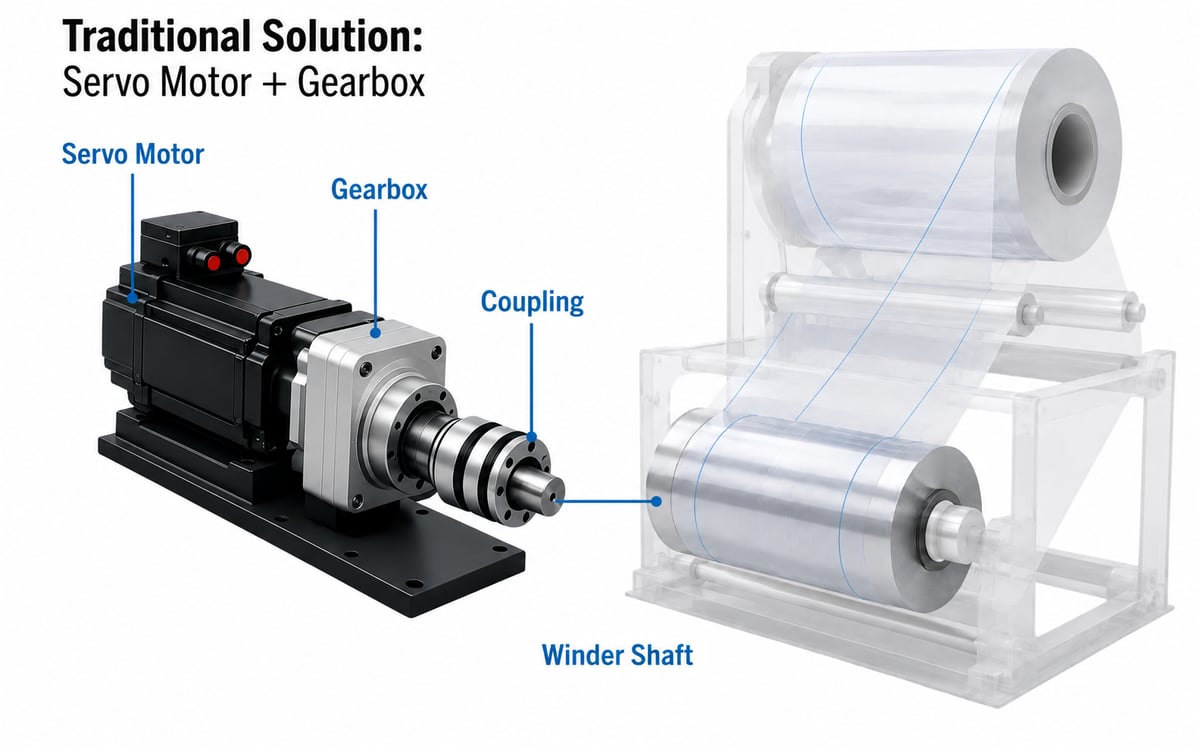
For decades, most winding machines have used a servo motor combined with a gearbox. The gearbox reduces speed and multiplies torque.
Advantages
- Widely available
- Familiar technology
- Lower initial motor cost
- Compact servo dimensions
Limitations
The gearbox introduces additional components into the torque path:
Servo Motor → Gearbox → Coupling → Winding Shaft
Each component creates mechanical losses, backlash, wear, and maintenance requirements. Over time, gearbox wear can affect winding consistency and tension stability.
Direct-drive solution: torque motor
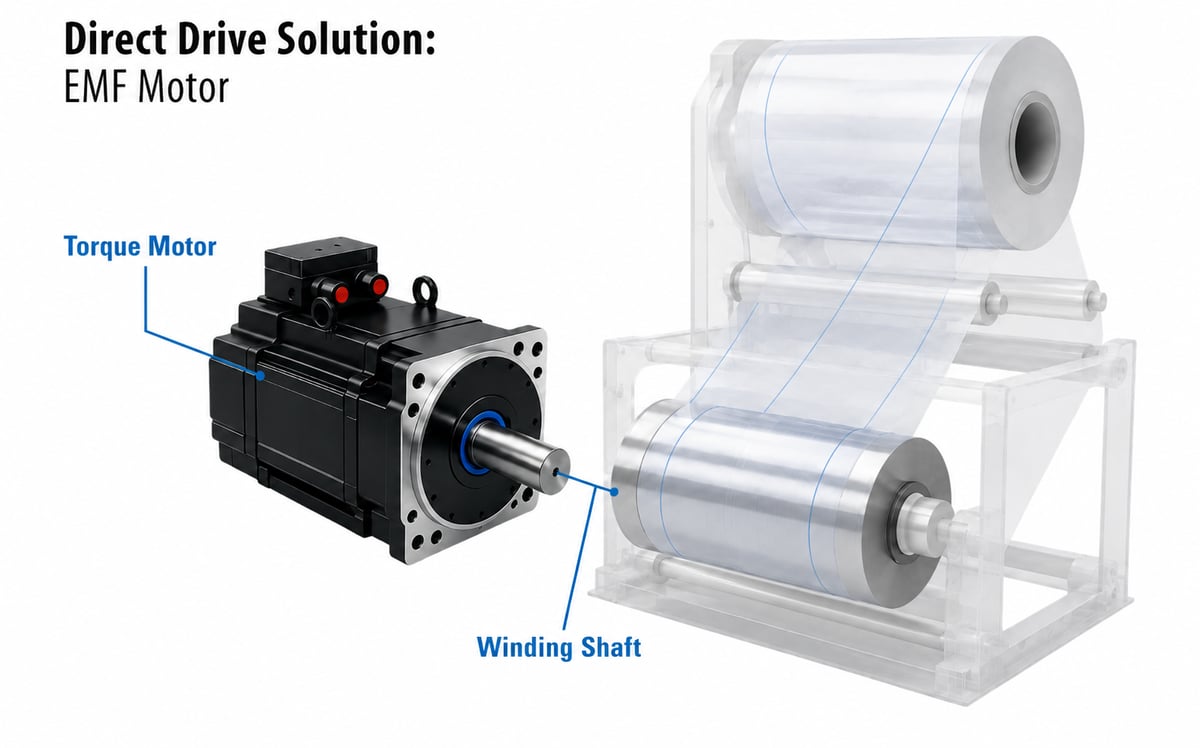
A torque motor eliminates the transmission entirely:
Torque Motor → Winding Shaft
No gearbox. No coupling. No transmission losses. The motor generates high torque directly at low speed. EMF Motor torque motors are designed specifically for direct-drive operation and can deliver full torque throughout the speed range while maintaining high efficiency and stable operation.
Comparison #1: Torque Accuracy
In winding applications, tension quality starts with torque quality. Small torque variations can produce wrinkles, telescoping, material stretching, and poor roll formation.
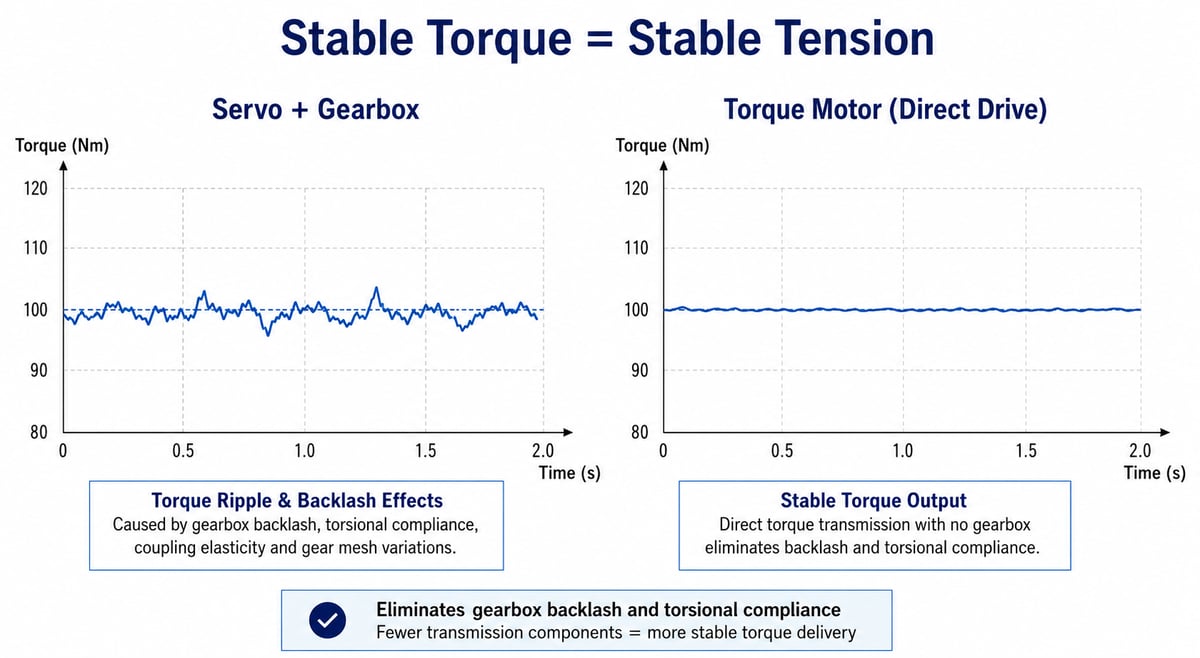
A gearbox introduces backlash and torsional compliance. These mechanical effects can reduce the accuracy of torque transmission. A direct-drive torque motor removes these mechanical elements entirely, giving a shorter and more predictable torque path. For materials such as battery foil, thin films, paper, and specialty laminates, this can significantly improve tension stability.
Winner: Torque Motor
Comparison #2: low-speed performance
Most winding applications spend a significant amount of time operating at low shaft speeds — large diameter rolls, startup sequences, splicing operations, and diameter transitions.
Servo motors typically achieve high torque through gear reduction; without the gearbox, motor torque may not be sufficient. A torque motor is designed to produce high torque directly at low speed. EMF Motor's high pole-count design (66–88 poles) enables stable torque production and low torque ripple even at extremely low rotational speeds.
Winner: Torque Motor
Comparison #3: energy efficiency
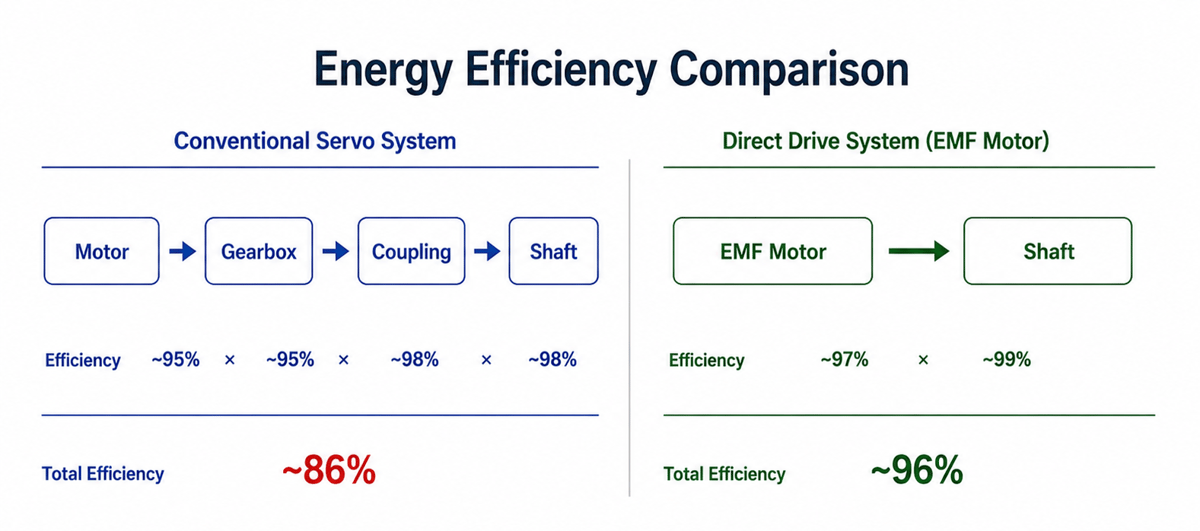
Every gearbox consumes energy. Typical losses arise from gear mesh friction, bearings, and lubrication drag — and these losses occur continuously. A direct-drive system eliminates gearbox losses entirely.
Over thousands of operating hours per year, the difference becomes significant. This is especially important in plastic film production, paper mills, metal processing, and battery manufacturing, where winding systems often run 24/7.
Winner: Torque Motor
Comparison #4: maintenance
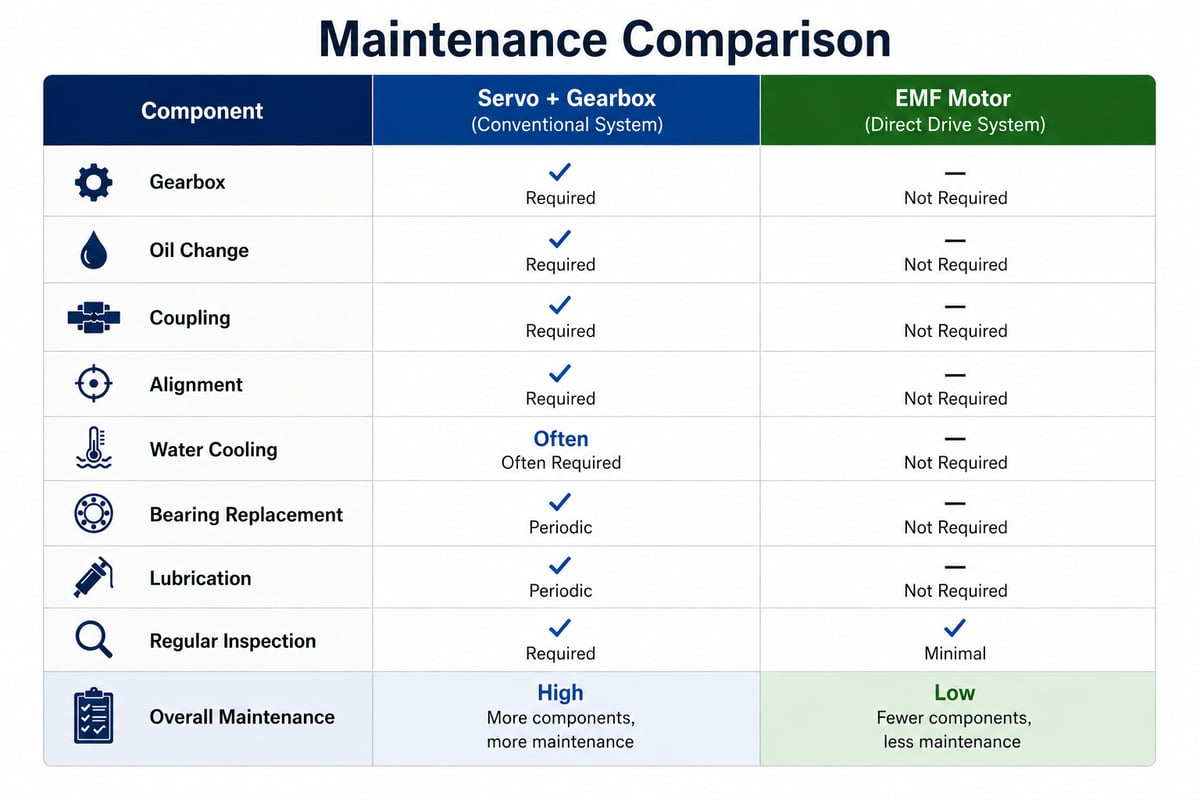
A gearbox requires lubrication, oil monitoring, seal inspection, and periodic replacement. Couplings require alignment and maintenance. A direct-drive torque motor removes these components. EMF Motor torque motors operate without gearboxes and without water-cooling systems, reducing maintenance requirements and simplifying machine architecture.
Winner: Torque Motor
Comparison #5: system complexity
Every additional component introduces installation effort, spare parts, failure points, and alignment requirements. Traditional systems include a servo motor, gearbox, coupling, and mounting hardware. Direct-drive systems eliminate several of these elements. Fewer components generally result in easier installation, higher reliability, and lower lifecycle costs.
Winner: Torque Motor
Comparison #6: dynamic response
Winders must react quickly to speed changes, diameter changes, tension disturbances, and material splices. The gearbox acts as a mechanical buffer between the motor and the load; while sometimes beneficial, it can also reduce responsiveness. A direct-drive motor is mechanically connected directly to the winding shaft, which often enables faster response to changing process conditions.
Winner: Torque Motor
Comparison #7: initial investment
This is the area where servo systems often appear attractive. A standard servo motor may have a lower purchase price than a large torque motor. However, the comparison should include gearbox cost, coupling cost, installation cost, maintenance cost, and energy cost. Many lifecycle analyses show that the cheapest motor is not always the lowest-cost solution over ten years of operation.
Winner: Depends on project priorities
Real example: servo replacement
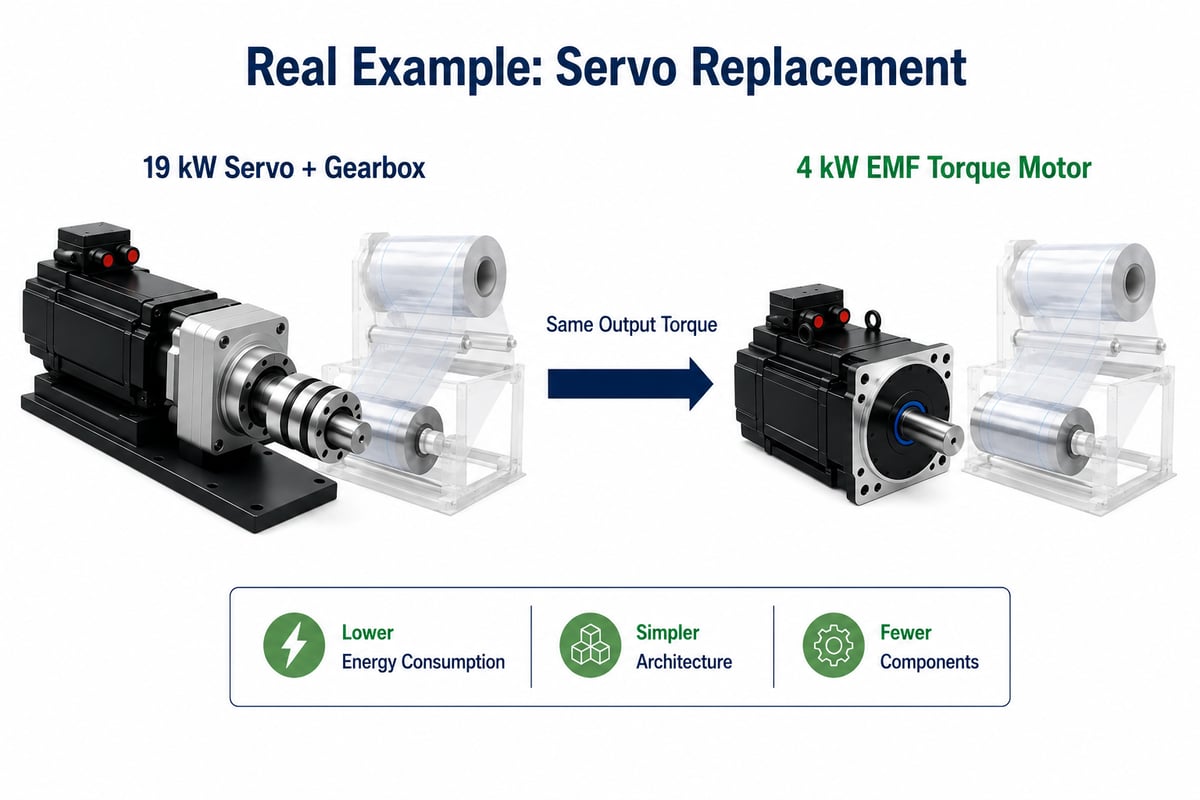
In one winding application, a 19 kW servo motor with gearbox was replaced by a 4 kW EMF Motor direct-drive solution while maintaining the same output torque. The result was lower energy consumption and a simpler drivetrain architecture. This example illustrates an important point: the objective is not motor power — the objective is usable shaft torque.
Which industries benefit most from torque motors?
Direct-drive torque motors are particularly attractive for:
- Plastic film winders
- Slitter rewinders
- Paper converting lines
- Metal coil processing
- Battery foil production
- Cable winding systems
- Textile winding machines
These applications typically require high torque at low speed, stable tension control, continuous operation, minimal maintenance, and high energy efficiency.
Final
If the primary objective is the lowest initial purchase cost, a servo motor with gearbox may still be a viable choice. However, if the objective is better tension stability, higher efficiency, reduced maintenance, lower lifecycle cost, simpler machine architecture, and superior low-speed performance, then a direct-drive torque motor offers clear advantages.
The question is no longer whether a torque motor can replace a gearbox-driven servo system. For many modern winding applications, the more relevant question is: why keep the gearbox at all?